
Successful Simulation of Arm Elevation Using Deltoid Activation Patterns and Nerve Cuff Electrodes
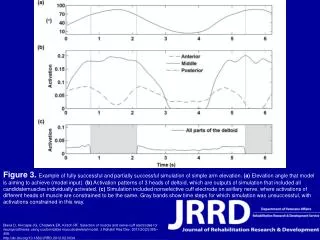
This study explores fully and partially successful simulations of arm elevation through a customizable musculoskeletal model. It examines the targeted elevation angle and the activation patterns of the deltoid muscle's three heads. Importantly, the simulation includes a nonselective cuff electrode placed on the axillary nerve, which constrains muscle activation patterns. The gray bands in the output indicate the time steps where the simulation was unsuccessful due to these constraints. The findings provide valuable insights for the development of neuroprostheses.

Successful Simulation of Arm Elevation Using Deltoid Activation Patterns and Nerve Cuff Electrodes
E N D
Presentation Transcript
Figure 3. Example of fully successful and partially successful simulation of simple arm elevation. (a) Elevation angle that model is aiming to achieve (model input). (b) Activation patterns of 3 heads of deltoid, which are outputs of simulation that included all candidatemuscles individually activated. (c) Simulation included nonselective cuff electrode on axillary nerve, where activations of different heads of muscle are constrained to be the same. Gray bands show time steps for which simulation was unsuccessful, with activations constrained in this way. Blana D, Hincapie JG, Chadwick EK, Kirsch RF. Selection of muscle and nerve-cuff electrodes for neuroprostheses using customizable musculoskeletal model. J Rehabil Res Dev. 2013;50(3):395–408.http://dx.doi.org/10.1682/JRRD.2012.02.0034