Natural Selection
This overview of evolution explores natural selection, a fundamental mechanism driving evolutionary change. It discusses microevolution, or shifts in gene frequency across generations, and macroevolution, highlighting the emergence of species from common ancestors. Key factors such as overproduction of offspring, inherited variation, competition for resources, and adaptations are examined. Natural selection favors individuals best suited to their environments, leading to the accumulation of advantageous traits. Understanding these concepts provides insight into the history of life on Earth.

Natural Selection
E N D
Presentation Transcript
Evolution Descent with modification or Change in a population over time Small-scale or microevolution: changes in gene frequency in a population from one generation to the next Large-scale or macroevolution: the descent of different species from a common ancestor over many generations. Evolution helps us to understand the history of life.
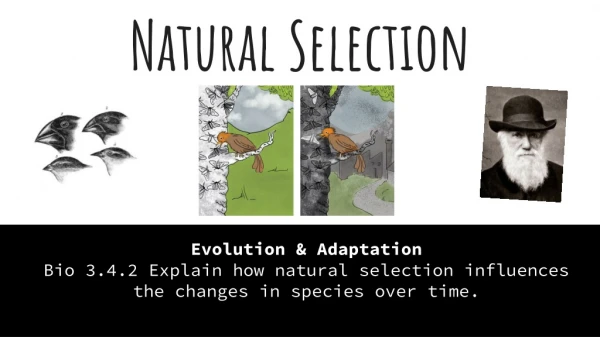
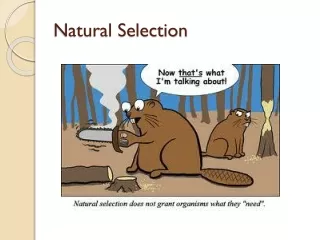
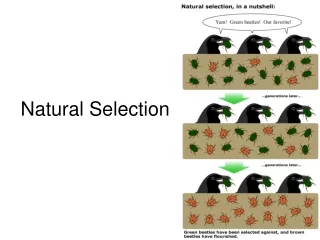
Natural Selection Natural selection is one of the basic mechanisms of evolution, along with mutation, migration, and genetic drift. Some factor in the Environment selects those individuals that are best suited to their environment to survive and reproduce, thus changing the population over time.
Overproduction of Offspring Organisms tend to produce more offspring than can survive.
Inherited Variation • Offspring are born with different traits (phenotype) because of different gene combinations. • Differences are the result of : mutations, crossing over, and/or independent assortment.
Competition to survive • There is a finite supply of environmental resources like… Food, shelter, mates, water, avoiding predation, sunlight, oxygen, etc.
Adaptation • Those individuals who are born with variations that help them to survive are said to have an adaptation. • Variation is random and so an individual cannot choose to have an adaptation • An advantage in one environment is sometimes a disadvantage in another.
Reproduction Survival of the fittest – those individuals who are better suited to their environment will survive and reproduce most successfully. It is the individual who leaves behind the most offspring who “wins”
Result • Over time traits that lead to more offspring accumulate in the environment and the population becomes better suited to their environment.
Activities • Read survival of the sneakiest article and answer the questions http://evolution.berkeley.edu/evolibrary/article/sneakermales_01 • Make a cartoon showing overproduction, variation, finite resources/competition, natural selection/differential survival and reproduction • Peppered moth simulation http://www.biologycorner.com/worksheets/pepperedmoth.html http://peppermoths.weebly.com/