Exploring the Computability of Combinators in BX Approaches
This paper investigates the limitations and possibilities of combinator-based BX (beyond Turing) approaches. It addresses questions about the computability of various combinator models, characterizing their properties, and methods for formal proofs. Key topics include the comparison of combinator models with rule-based and bidirectionalization models, the expressibility of functions akin to Turing machines and Lambda calculus, and the challenges of encoding data types while adhering to totality requirements. This work aims to deepen our understanding of computational models and their boundaries.

Exploring the Computability of Combinators in BX Approaches
E N D
Presentation Transcript
Computability of Combinators Position Statement Yingfei Xiong, Peking University, 2013
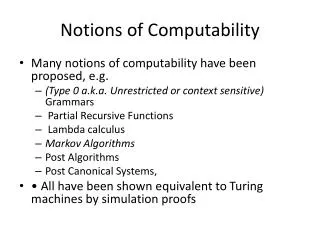
Computability of Combinators • Many BX approaches are built on top of combinators • Is there a limitation of the combinator model? • What is the computability of any possible combinator-based BX? • How to characterize the computability? • How to prove the characterization? • Combintor model could be replaced by • Rule-based model? • Bidirectionalization model? • Anything else?
Turing-Computable / Lambda-Computable BX • Could express any two functions, get and put, expressible in a Turing machine/Lambda Calculus that • satisfy GETPUT and PUTGET • are total functions • Problems: • How to encode different data types? • Probably not true because of the totality requirements, but how to formally prove it? • What weaker model could possibly be?