Understanding Ecosystems: Energy Flow, Chemical Cycling, and Trophic Levels
Explore the intricate relationships within ecosystems, focusing on energy flow and chemical cycling. This chapter discusses how energy moves through various trophic levels—starting with primary producers, then moving to primary and secondary consumers, and finally detritivores. Learn about primary productivity, the significance of nutrients, and the implications of energy transfer inefficiency. We also delve into the impact of human activity on ecosystems, including pollution, and discuss key biogeochemical cycles crucial for understanding the environment.

Understanding Ecosystems: Energy Flow, Chemical Cycling, and Trophic Levels
E N D
Presentation Transcript
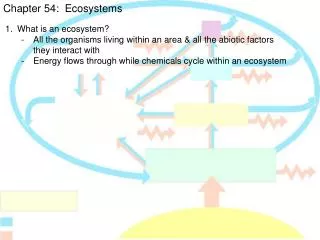
Ecosystem • All the organisms and abiotic factors in a community.
Ecosystem Studies 1. Energy Flow – the movement of energy through trophic levels. 2. Chemical Cycling – the movement of matter from one part of the ecosystem to another.
Trophic Levels • Division of an ecosystem based on the source of nutrition (energy).
Trophic Levels 1. Primary Producers 2. Primary Consumers 3. Secondary Consumers 4. Detritivores
Primary Producers • Usually plants, capture energy and store it in chemical bonds. • Are the source of the energy available to an ecosystem.
Primary Consumers • Organisms that feed on the producers. • Ex: Herbivores
Secondary Consumers • Organisms that feed on the Primary Consumers. • Ex: Carnivores
Comment • There may be several layers of Secondary Consumers in an ecosystem.
Get their energy from the organic waste produced by all levels. Ex: bacteria and fungi Detritivores
Network showing all the feeding relationships in an ecosystem. Food Webs
Primary Productivity • The rate at which light energy is captured by autotrophs or primary producers.
Primary Productivity • NPP = GPP - Rs • NPP = Net Primary Productivity • GPP = Gross Primary Productivity • Rs = Respiration
Available Energy • Daily - 1022 joules of solar radiation. • 1% - captured by Ps. • About 170 billion tons of organic matter is created each year.
Primary Producers • 50 - 90% of GPP is lost to Rs by the primary producers. • NPP = 10 - 50% • Animals - use only NPP, which limits the food webs.
Limiting Factors • Material or nutrient that is not present in sufficient quantity for the primary producers. • Ex: N, P, K, Mg Light, CO2
Energy Transfers • Not 100% efficient. • Why? • Second law of thermodynamics. • Waste. • Materials that can’t be digested etc.
Energy Transfer • Averages 10% with each Trophic Level change.
Question ? • Why do most ecosystems have only 3 - 4 trophic levels? • There isn’t enough energy passed up through the food web to support more levels.
Implications • There has to be fewer high level consumers in a food web. • The higher level consumers usually need a large geographical area.
Question • Which would support more humans per area? • Eating meat? • Eating plants?
Pyramids • Graphical representation of relationships in ecosystems. • Ex: 1. Productivity 2. Biomass 3. Numbers
Chemical Cycling • Matter is recycled through ecosystems. • Ex: Biogeochemical Cycles
Matter Reservoirs 1. Organic Materials 2. Inorganic Materials • Available Unavailable
Homework • Behavior Lab – Mon. 5/7 • Chapter 53 – today • Chapter 54, 55 – Mon. 5/7 for x-credit • Exam 4 – Mon. 5/7, 12:00 Burkhardt 100
Representative Cycles • Water • Carbon • Nitrogen • Know one or more of these cycles for an essay question.
Energy vs Matter • Energy - flows through ecosystems and is mostly lost as heat. • Matter - cycles in ecosystems.
Question ? • What is Man's influence on Ecosystems ? • Humans have had many negative impacts.
Biological Magnification • The concentration of toxins in successive levels of a food web. • Ex: DDT Heavy metals (Hg, Cd Pb)
Causes • Not broken down by digestion/decomposition. • Lipophilic. • Concentrates and effects the upper levels of the food web.
Greenhouse Effects • The trapping of heat by the Earth's atmosphere. (CO2, H2O etc.).
Carbon Dioxide Levels • Prior 1850 - 274 ppm 1958 - 316 ppm 1992 - 351 ppm • Point: the levels of CO2 are rising. The cause is probably due to humans.