Download
1 / 8
80 likes | 189 Views
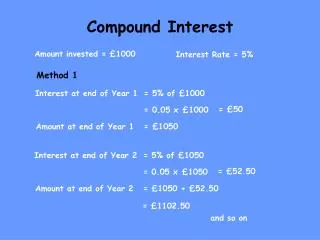
This guide explains compound interest, illustrating three methods for calculating the amount accrued from an investment of £1000 at a 5% interest rate. Method 1 calculates interest at the end of each year, accumulating to £1102.50 in Year 2. Method 2 utilizes an exponential formula, also leading to £1102.50 at Year 2. Method 3 confirms the results through a general formula for exponential growth. Further, examples of radioactive decay demonstrate similar principles in a different context, clearly showcasing growth and decay trends.

E N D
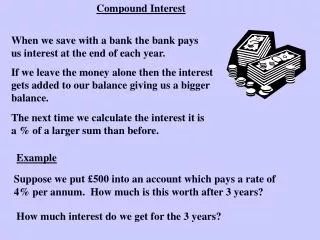
Compound Interest Amount invested = £1000 Interest Rate = 5% Method 1 Interest at end of Year 1 = 5% of £1000 = £50 = 0.05 x£1000 Amount at end of Year 1 = £1050 Interest at end of Year 2 = 5% of £1050 = £52.50 = 0.05 x£1050 Amount at end of Year 2 = £1050 + £52.50 = £1102.50 and so on
Compound Interest Amount invested = £1000 Interest Rate = 5% Method 2 Amount at end of Year 1 = 105% of £1000 = 1.05 x£1000 = £1050 = £1102.50 Amount at end of Year 2 = 1.05 x£1050 and so on
Example – Compound Interest £1000 invested at 5% interest 1050.00 1102.50 1157.63 1215.51 1276.28
Compound Interest Amount invested = £1000 Interest Rate = 5% Method 3 = 1.05nx£1000 Amount at end of Year n = 1.052x£1000 = £1102.50 Amount at end of Year2 = 1.0510x£1000 = £1628.89 Amount at end of Year10
General Formulae Exponential Growth y = kamx k, a and m positive a > 1 Example – Compound Interest A = 1.05nx£1000 x is n y is A a = 1.05 k = 1000 m = 1 Can be written in other forms: A = 1.10250.5nx£1000 k = 1000 a = 1.1025 m = 0.5
Example – Radioactive Decay Plutonium has a half-life of 24 thousand years 500 24 250 48 125 72 62.5 96 120 31.25
A = 1000 x2-0.0416t where t = time in thousands of years Example – Radioactive Decay of Plutonium Decay functions A = 1000 x0.5n where n = no. of half lives A = 1000 x2-n where n = no. of half lives A = 1000 x2-t/24where t = time in thousands of years Exponential Decay a < 1 m positive k and a positive y = kamx a > 1 m negative
General Shape of Graphs Exponential Growth Exponential Decay