Download
1 / 25
250 likes | 365 Views
This proposal outlines a 20-acre viticulture project aimed at creating a self-sustaining and community-supported vineyard at Crater School District. Presented by Paul Anderes and Kristin Kostman, the initiative focuses on student involvement, quality product cultivation, market research, and community events. The project utilizes student labor for hands-on agricultural experience and promotes local wineries through community outreach. Key goals include establishing a community-friendly facility, providing educational opportunities, and leveraging the area's rich viticultural history.

E N D
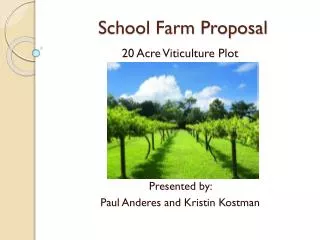
School Farm Proposal 20 Acre Viticulture Plot July 16, 2010 Presented by: Paul Anderes and Kristin Kostman
Project Goals: • Self-Sustaining & Community Supported • Initial cost • Student labor • Market research to support variety selection • Quality product
Project Goals: • Community Friendly Facility • Facility appearance and management • Community gathering facility for events • Open for public and informational tours • Research facility for university and college
Project Goals: • Student involvement • Lab experience • Work experience • Supervised Agriculture Experience (SAE) • Marketing • Agriculture Engineering & Mechanics
Marketing Plan: Product • History – Rogue Valley Winegrape • 1st vineyards in the Southern Oregon were planted in the mid 1800’s by Peter Britt • Britt grew over 200 varieties • 2007 over 53 varieties are being grown • 2007 Top 10 Winegrape Varieties • Pinot Noir, Malbec, Syrah, Cabernet Sauvignon, Pinot Gris, Chardonnay, White Riesling, Gewurztramin, and Pinot Blanc
Marketing Plan: Place • Crater School District 6 (CDS) • 20 acre Land Laboratory • Rogue River Valley • Elevation: 1300’ to 1800’ • GDD: 2600 to 2800 • Rainfall: 18” annually • Best soil in the valley floor • Irrigation available
Marketing Plan: Promotion • Community Outreach • Radio advertising • Row sponsors • Facility use • Tours • CHS/FFA Winegrape Auction in conjunction with Harvest Fair • Contract one of each variety to three different award winning wineries in the Rogue Valley
Land Requirement Analysis: • Rogue River Valley • Similar to the Bordeaux Region of France in latitude and cool ocean breezes • Elevation: 1300’ to 1800’ • GDD: 2600 to 2800 • Rainfall: 18” annually • Best soil in the valley floor • Irrigation available
Pest/Disease Management Plan: • Soil • Sample soil for nematodes • Pre-planting test • Gophers and other burrowers • Live traps • Plant material • Obtain “certified” plants stock • Rootstock • Graft vines to prevent phylloxera damage • phylloxera = root feeding insect
Five Crop Stages & Pest Mgt. • Pre-Plant/Planting • Bud Swell through Bloom • Bloom to Veraison (berry softening/beginning of ripening) • Veraison to Harvest • Post-Harvest/Dormant
Pre-Plant/Planting August to May • Site preparation and pre-plant activities affecting pest management(August to planting) • Planting of new vines (takes place between January and May)
Bud Swell through Bloom • Mid-March to June • Includes all activities in both new/nonbearing and established/bearing • vineyards during the spring
Bloom to Veraison (berry softening/beginning of ripening) • June to August • Includes late spring/summer activities for both new/nonbearing and • established/bearing vineyards
Veraison to Harvest • August to October • Includes any activities that take place between veraison and completion of • Harvest • Includes any aspects of harvest that affect the crop’s pest issues
Post-Harvest/Dormant • October to Mid-March • Includes any pest management activities that take place immediately • following harvest • Includes any pest management activities that take place during the • dormant season on established plantings
3-Year Budget: Labor • Ag Teacher contract= $10,000 including benefits • Student Labor= FREE • Vineyard will be instead of traditional fundraising activities
Summary- Profit/Loss Statement After 3 years, initial investment is recouped by the district meeting or exceeding industry standard.
References: • http://wine.oregonstate.edu • http://extension.oregonstate.edu/catalog/ • http://berrygrape.oregonstate.edu/ • http://oregonstate.edu/dept/press/o-p/OregonViticulture.html • http://www.nass.usda.gov/Statistics_by_State/Oregon/Publications/Vineyard_and_Winery/index.asp • http://oregonstate.edu/dept/NWREC/decision_tools/download.php
References continued: • http://extension.oregonstate.edu/catalog/ • http://oregonstate.edu/dept/mcarec/enterprise.php • http://smallfarms.oregonstate.edu/ • http://www.usgs.gov • http://www.atf.gov/alcohol/info/faq/wine.htm • info@oregonwine.org • http://www.wrcc.dri.edu/summary/climsmor.html • http://www.usbr.gov/pn/agrimet/webarcread.html • http://www.ocs.oregonstate.edu/index.html
References continued: • http://websoilsurvey.nrcs.usda.gov/app/ • http://smallfarms.oregonstate.edu/soil-testing • www.bcc.orst.edu/bpp/Nematodes/Nematode_Testing_Service_Form.pdf • http://www.wrd.state.or.us/ • http://www.nass.usda.gov/Statistics_by_State/Oregon/Publications/Vineyard_and_Winery/index.asp • http://wine.oregonstate.edu/winegrape
References continued: • http://ngr.ucdavis.edu/index.cfm • http://fpms.ucdavis.edu/ • http://nwgfs.wsu.edu/ • http://nwgfs.wsu.edu/certified.html • http://egov.oregon.gov/ODA/PLANT/docs/pdf/quar_grape.pdf