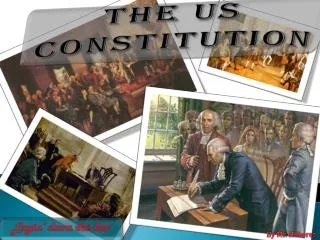
The US Constitution
Learn about the US Constitution, its key principles, structure, and the importance of the Preamble. Explore the roles of the three branches of government and the system of checks and balances.

The US Constitution
E N D
Presentation Transcript
The US Constitution Chapter 8
Bell Ringer for Monday, Nov. 12 • Use the timeline and map on pages 246-247 to answer these. • What year was the Constitution written? • What did the 15th Amendment do? • How many electoral votes does MS have? • Which states’ electoral votes could you add together to get as many electoralvotes as California?
Goals of the Preamble • To form a more perfect Union • Framers wanted a unified nation • E Pluribus Unum • To establish justice • Unified legal system applied fairly to all
Goals of the Preamble • To insure domestic tranquility • Peace and order at home • National Guard’s help after a disaster • To provide for the common defense • Power to raise armies and navies • Military under civilian control
Goals of the Preamble • To promote the general welfare • Well-being of all citizens • To secure the blessings of liberty • Many have fought and died for liberty • Amendments have extended liberty
Preamble to the US Constitution • We the people of the United States, • in order to form a more perfect union, • establish justice, • insure domestic tranquility, • provide for the common defense, • promote the general welfare, • and secure the blessings of liberty to ourselves and our posterity, • do ordain and establish this Constitution for the United States of America.
Articles (Body) of the Constitution • Articles I-III-Branches of government • Article IV-Relations among the states • Article V-Amending the Constitution • Article VI-National Supremacy • Article VII-Ratification
Key Terms • Use this definition for 3)popular sovereignty-a principle of the United States Constitution that maintains government gets its power from the people
7 Principles of the Constitution • Popular Sovereignty • Limited Government • Separation of Powers • Checks and Balances • Federalism • Republicanism • Individual Rights • We will summarize each of these in ten words or less
Bell Ringer for Tuesday, Nov. 13 • Turn to page 250. • Look at the “System of Checks and Balances” chart. • Answer questions one and two under Chart Skills.
Key TermsDue on Wednesday, Nov. 14 • First Amendment • Second Amendment • Nineteenth Amendment • Twenty-sixth Amendment • Initiative • Citizen • Naturalize • Immigrant • Patriotism • Civilian • Liberty • *Popular sovereignty • Checks and balances • Federalism • Bill • Electoral college • Appeal • Unconstitutional • Veto • Impeach
Reciting the Preamble • On Tuesday, November 27, you will recite the Preamble to the US Constitution for a grade. • There are only 52 words in the Preamble. • Many of you memorized the Preamble in 5th grade.
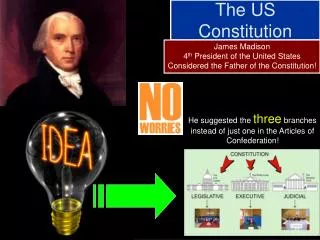
7 Principles of the Constitution • Popular Sovereignty-government gets its power from the people • Limited Government- government has only the powers that the Constitution gives it • Separation of Powers- government is divided into three branches to limit government’s power
7 Principles continued • Checks and Balances- each branch can check, or limit, the other branches’ actions • Federalism-division of power between the federal government and the states
7 Principles continued • Republicanism-citizens elect representatives to take care of the government’s business • Individual Rights-citizens’ rights are protected under the Constitution (Bill of Rights)
Bell Ringer for Wed., Nov. 14 • Turn to page 253. • Look at the “Federal Officeholders” chart. • Answer questions one and two.
Legislative Branch-Senator • Requirements • 30 years old or older • Citizen of the US for at least 9 years • Resident of state in which elected • 6 year term • 100 Senators total
Legislative Branch-Representative • Requirements • 25 years old or older • Citizen of the US for at least 7 years • Resident of the state in which elected • 2 year term • 435 Representatives
Executive Branch-Pres. And VP • Requirements • 35 years old or older • Natural-born citizen • Resident of the US for 14 years • 4 year term • 1 team
Judicial Branch-Supreme Court • Requirements • No Constitutional requirements • Lifetime appointment • 9 total Justices
Legislative Branch-Powers • MOST IMPORTANT IS TO make the nations laws • Collect taxes • Borrow money • Coin money • Declare war • Elastic Clause-Congress can make all laws that are necessary and proper
Legislative Branch-Checks on Ex. Branch • Can override President’s veto • Confirms executive appointments • Ratifies treaties • Can declare war • Appropriates money • Can impeach and remove the President
Legislative Branch-Checks on Jud. Branch • Creates lower courts • Can impeach and remove judges • Can propose amendments to overrule judicial decisions • Approves appointments of federal judges
Executive Branch-Powers • Carries out the nations laws • Directs foreign policy • Is Commander in Chief of the Armed Forces • Can make treaties and appoint ambassadors • Can grant pardons and call special sessions of Congress
Executive Branch-Checks on Leg. Branch • Can propose laws • Can veto laws • Can call special sessions of Congress • Makes federalappointments • Negotiates foreign treaties
Bell Ringer for Thursday, Nov. 15 • True or False • The US Constitution has only 10 amendments. • The United States’ official religion is Christianity. • The government can regulate gun ownership.
Executive Branch-Checks on Jud. Branch • Appoints federal judges • Can grant pardons to federal offenders
Judicial Branch-Powers • Greatest power is to decide what the Constitution means
Judicial Branch-Checks on Ex. Branch • Can declare executive actions unconstitutional
Judicial Branch-Checks on Leg. Branch • Can declare acts of Congressunconstitutional
Bill of Rights • Bill of Rights-first 10 amendments to the US Constitution; added in 1791 • Since 1791, 17 morehave been added
Bill of Rights • First Amendment- protects basic individual liberties such as religion, speech, press, assembly, and petition • Second Amendment-right to bear arms
Bill of Rights • Third Amendment- citizens cannot be forced to house troops • Fourth Amendment- guards against unlawful searches and seizures
Bell Ringer for Monday • Review Questions • How many principles are there in the Constitution? • What are the qualifications for President? • How many total amendments are in the Constitution?
Assignments this Week • You will have to recite the Preamble to the US Constitution tomorrow, TUESDAY, November 27, in class. • You will have a key terms quiz on WEDNESDAY, November 28. • Your chapter eight TEST will be on Friday, November 30.
Bill of Rights • Fifth Amendment-citizens cannot be forced to incriminate themselves • Sixth Amendment-right to speedy trial by jury • Seventh Amendment-right to jury trial in civil cases • Eighth Amendment-bans excessive bail and punishment
Bill of Rights • Ninth Amendment-citizens’ rights are not limited to the ones listed in the Bill of Rights • Tenth Amendment-all powers not given to the federal government are reserved for the people (states)
Later Amendments • Since 1791, only 17 more amendments have been added to the Constitution • Bill of Rights 10+17=27 totalamendments • Other amendments have extended liberty
Reciting the Preamble • You may have up to five minutes to prepare for reciting the 52 words of the Preamble to the US Constitution. • You can use pages 248- 249 to study if you need to.
Reciting the Preamble • Here are THE RULES. • Volunteers first! • I will select after that! • You can only have the paper I gave you on your desk. • If you are disruptive while some one else is reciting: • First time is -10 points for you • Second time-writing assignment or office referral and you are next
Chapter 8 Key Terms Quiz • You may have a few minutes to look over your key terms in preparation for the key terms quiz today.
Bell Ringer for Thursday, Nov. 29 • Turn to page 267. • Look at the “Political Cartoon- Young Voters.” • Answer the questions.
US Citizenship • Requirements for US citizenship • Born in the US or at least one parent is US citizen OR • Naturalized-legal process for becoming a US citizen OR • 18 or younger when your parents were naturalized
What is a Citizen?-Naturalization • Immigrant • Resident alien • Five year waiting period • Apply for citizenship • Complete an exam • Show “good moral character” • Interview • Take an Oath of Allegiance
Rights and Responsibilities • Equal rights under the law • Not based on wealth or family • With these rights comes responsibilities • Freedom is not free
Virtue and Values • Patriotism-feeling of love and devotion to the US • Respect-for ourselves, others, property, and laws • Responsibilities and consequences • Courage-physical or moral courage
Responsibilities • Voting-know the candidates and issues • Obey the Laws-know and follow the law • Defend the Nation-register for draft or volunteer to serve • Serve on Juries-take time to decide others fate • Serve the Community-volunteer, donate blood, give money and supplies • Be Informed-read the news and pay attention in class
Chapter 8 TEST • You may have a FEW minutes to look over your notes in preparation for the TEST.