Download
1 / 6
80 likes | 210 Views
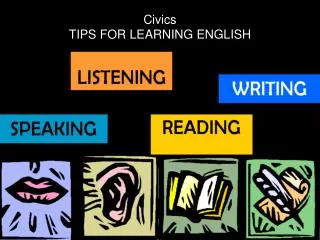
To master English listening comprehension and speaking fluently, learners should engage with audio and video materials in English, such as dialogues, thematic texts, and narratives. Using transcripts enhances understanding. Suggested practices include repeating sentences aloud, listening in chunks, and recounting main ideas from stories. Regularly comparing spoken output to transcripts is crucial for improvement. Following these techniques allows learners to build a solid foundation in pronunciation, vocabulary, and grammar, ultimately leading to effective verbal communication in English.

E N D
How to Practise English Listening Comprehension and Speaking Skills In order to have good skills in listening comprehension in English and to speak it fluently, a learner should practise listening to audio and video aids in English (dialogues, thematic texts and narrative stories). It is preferable to have English transcripts of audio and video material. I suggest that learners practise listening comprehension with subsequent speaking in the following sequence:
How to Practise English Listening Comprehension and Speaking Skills • Listen to each sentence several times. At the same time see each sentence in the transcript. • Make sure you understand everything clearly in each sentence in terms of pronunciation, vocabulary and grammar.
3. Without looking into the transcript, try to repeat each sentence (say it aloud) exactly as you heard it. Without being able to repeat a sentence, a learner cannot understand it. 4. Listen to that particular conversation or text (story) in short paragraphs or chunks, say each paragraph aloud, and compare to the transcript.
5. Listen to the whole conversation or story without interruption several times, and try to tell the content of the whole conversation or text (story) you heard. You can write key words and phrases, or main ideas as a plan, or questions on that particular dialogue or text to make easier for you to convey the content in English. It is important to compare what you said to the transcript.
Source • Taken from : http://www.omniglot.com/language/articles/learningenglishtips.htm