Stem Structure Function in Plants
450 likes | 556 Views
Learn about the parts and functions of the stem, including support, conduction, growth, and storage. Discover how stems store water and food, and explore stem morphology and anatomy.


Stem Structure Function in Plants
E N D
Presentation Transcript
Competencies:To identify the parts and functions of the stem and its classifications
Pre Activity:1. Get a sample of a STEM (by group)2. Recall the parts of the stem
Stem Functions • Stems have the following 4 functions or jobs: • Support • Conduction • Growth • Storage
Support • Stems support the plant’s leaves, flowers, and fruits.
Conduction • Like roots, stems contain vascular tissue (xylem and phloem). • Xylem conducts water and minerals. • Phloem conducts the sugars created during photosynthesis.
Growth • During the growing season, cell division and elongation are occurring in both the apical and lateral meristems of dicots. • This results in plant growth. • The same things are occurring in the intercalary meristems of monocots.
Storage • Stems are sometimes modified to store food and (or) water. • Plants that store large amounts of water in their stems or leaves are called succulents.
Succulents • Cacti are examples of succulent plants that store water in their stems. • The spines are modified leaves.
Tuber • A potato is a special type of underground stem called a tuber. • Tubers store excess carbohydrates manufactured during photosynthesis. • Don’t confuse tubers with tuberous roots. Tuberous roots are root modifications, tubers are modified stems.
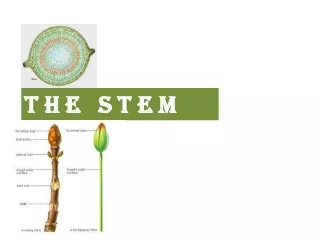
Stem – part of the plant above the hypocotyls which bears leaves, flowers and fruits. Hypocotyl - attachment of cotyledon and stem. Stemless plants are Acaulescent plants.
External Structures: 1. Nodes and Internodes – points on stem from which leaf develop – Nodes section of the stem between two successive nodes – Internodes
Leaf Axil Leaf blade Petiole
2. Buds – undeveloped structure of stem. Types: 1. terminal – tip of the stem 2. lateral – side of stem 3. adventitious – at any point of stem
Stem Morphology, continued • Bud: a structure on a stem containing a dormant apical meristem. • Buds are usually, but not always, covered by protective scales. • Can be terminal or lateral in position. • Come in 3 basic types: • Vegetative • Flower • Mixed
bud scales naked bud of V. carlesii
Stem Morphology, continued • Terminal bud scale scars: mark the location of last seasons terminal bud. • Leaf scars: scars marking the location of last seasons leaves. • Vascular bundle scars: found inside leaf scars, these scars mark the location of the vascular bundles that passed from the stem, through the leaf petiole, and into the leaf blade.
3. Lenticels – corky postules found in older stem which allow gaseous exchange. • Not all stems have lenticels.
4. Stomata - - postules found in younger stem for gas exchange
Trichomes – • epidermal hairs in young stem for protection and water proof.
6. Leaf scar – marks by falling of leaves. 7. Bundle scar – marks by strand of vascular bundles.
SECONDARY GROWTH • refers to all growth which takes place as a result of cambial activity – increase in diameter. • Additional cells: • secondary xylem – within cambium rings • 2. secondary phloem – outwardly found.
Two Regions become Distinct: • Bark – tissue outside cambium rings composed of phloem, pericyle, cortex and periderm. • Wood – all tissue inside cambium rings.
Stem Anatomy Terminology • Wood: xylem tissue • Springwood: large, thin-walled xylem cells produced in the spring of the year when water is usually in abundant supply. • Summerwood: smaller, thicker-walled xylem cells produced during the summer when water availability is more limited.
Stem Anatomy Terminology • Annual Ring: one annual growth ring represents the amount of springwood and summerwood that has occurred in a single growing season. • Trees growing in the tropics, where the temperature is constant and rainfall occurs daily, do not produce annual growth rings.
Springwood-Summerwood Cross-sectional view of a 3-year old woody, dicot stem Vascular Cambium Summerwood yr 3 Springwood yr 1 Summerwood yr 1 Springwood yr 2 Summerwood yr 2 Springwood yr 3
Heartwood • Heartwood: As xylem ages it becomes plugged with resins and other waste products. • When this happens the xylem (wood) becomes stained a dark color. • Heartwood is not functional xylem. It no longer conducts water. • It does, however, help strengthen the trunk of a tree.
Sapwood • Sapwood: xylem that is actively conducting water. • Lighter in color than heartwood. • Surrounds the heartwood.
Transport/ Food Conduction (By Products) • Starch – chief reserved substances • Latex – milky juice – inorganic materials • Resins and Gums – contained intercellular passages – turpentine. • Oils – eucalyptus, coconut, soy beans
Spurs • Short, slow-growing stems that bear leaves, flowers, or fruit. • Not found on all species.
Rhizomes • An underground stem. • Usually grows horizontally. • Capable of producing new shoots and roots. Iris
Stolons • Aboveground stems that “run” across the soil surface. • Horizontally growing. • Produce new shoots and roots. Strawberry stolons
Corms • Compressed, swollen vertical stem. • Papery covering. • Found underground. • Crocus and Gladiolus are examples. Gladiolus corms
Bulbs Tunicate bulb • Underground. • Two different kinds: • Tunicate bulbs have a papery outer covering. An onion is an example. • Scaly bulbs lack a papery outer covering. Lily bulbs are an example. Scaly bulb
PROPAGATION Inarching – rooted plants are joined by tying their stem together.
Grafting – 2 fleshy cut stem are bound-together. Base – stock; grafted – scion
Marcotting – for fruit bearing – girdling of selected bushes with soil and wrapped in cellophane.