Download
1 / 38
380 likes | 1.03k Views
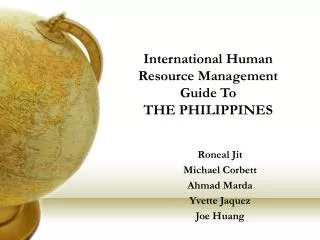
International Human Resource Management Guide To THE PHILIPPINES. Roneal Jit Michael Corbett Ahmad Marda Yvette Jaquez Joe Huang. IHRM Guide to The Philippines. Host Country Profile: Philippines Parent Country Profile: United States US-Philippines Cultural Gap Analysis

E N D
International Human Resource Management Guide To THE PHILIPPINES Roneal Jit Michael Corbett Ahmad Marda Yvette Jaquez Joe Huang
IHRM Guide to The Philippines • Host Country Profile: Philippines • Parent Country Profile: United States • US-Philippines Cultural Gap Analysis • Company Case Study: Ford Motor Co. • IHRM Issues • Role of IHRM in Cross Cultural Ethical Issues and Corporate Social Responsibility
Geography Area: 300,000 sq. km. (117,187 sq. mi.).Capital: ManilaTerrain: Islands, 65% mountainous, with narrow coastal lowlands.Climate: Tropical.
People Population (2000 census): 76.5 million. Government’s estimate for 2003: 82.0 million Annual growth rate: 2.36%.Ethnic groups: Malay, Chinese.Religions: Catholic 85%, Protestant 9%, Muslim 5%, Buddhist and other 1%.Languages: Tagalog, English, language of government and instruction in education.Education: .Literacy: 92.3%. Life expectancy ( 2003): 67.2 yrs. for males; 72.5 yrs. for females. Work force ( 2003): 34.6 million. Services (including commerce and government): 48%; agriculture: 36%; industry: 16%.
Government Type: Republic.Independence: 1946.Constitution: February 11, 1987.Suffrage: Universal, but not compulsory, at age 18.
Home Country Profile:United States • Economic & Military Super Power • Characteristics of Americans: • Independent • Straight Forward • Value Time • Current Issues • Outsourcing
Cultural Gap Analysis: US-Philippines • Shared History • Institutions • Family Values • Education • Work Norms
Ford Motor Company • History and Business Profile • Mass Production • Globalization • Company Financial
IHRM ISSUESTarget Country: PhilippinesParent Country: USCompany: Ford Motor Co.
ASEAN Ford • Confidence • Economic • Employee • Environment • Growth
IHRM & Ford • Compensation & Recognition • Staffing • Development • Cultural Gap
MAP • “The skillful management of people turns out to be the most critical single ingredient to helping business survive & excel…”
Continued Education Awareness Empowerment Open-Book Responsibility Efficient Communication Increased Productivity & Utilization 1991- 10% Today- 64% & 70% Export Production “People Vision”
The BIG Picture • Employers Confederation of the Philippines (EcoP) • Social Leadership • Human Resource Development • “Big Brother – Small Brother”
An Outsider’s Opinion • Expatriates rank Philippines #2 • Friendly Attitude • Education • Housing • Health Care • Sporting & Recreation
Role of IHRM in Cross Cultural Ethical Issues & Corporate Social Responsibility
Corporate Social Responsibility • Definition and Scope • Globalization Effect • Legal issues • Home Country • Host Country • International Standard
5 Stages of Corporate Responsibility • Defensive • Compliance • Managerial • Strategic • Civil
Human Resources Training and Stages of Social issues • Latent • Emerging • Consolidating • Institutionalization
The Philippines • Political Environment • Social Environment • Economic Condition • Labor Practices
Corporate Strategy and Responsibility • Economics • Social • Markets • Outsourcing
Special Economic Zones (SEZ) • Ford Philippines Assembly Plant • No. 1 American Road, Greenfield Automotive Park,Special Economic Zone, Sta. Rosa, Laguna, Philippines 4026 • Zones are a key role in attracting new investors to the country • Tax incentives • Low corporate income tax rates • Indirect access to governmental administrative services • Minimum government influence • Administers their own economic, financial, industrial and tourism development
The SEZ • Abuse in the SEZ • Many industries using extralegal methods are successful in preventing the formation of unions • Poor working conditions • Ford Motor Co. • Keeping their workforce happy to avoid unionization • Provide sufficient benefits and rights to the trained workforce
Labor Force • 1996 Labor Code • Allow all private and public sectors workers with the exception of the military and police, to freely associate and to form or join a union • Forced labor is prohibited by the Constitution, but bonded labor of children known to occur • Children in the labor force • Approximately 3.7 million children are economically active • At least 2 million are working in hazardous condition • Can work at the age of 12 with parental consent • Can not work more than 6 hours a day and can not work at night
Cont. • Standard workweek • 48 hours for most industries • 40 hours for government workers • Work beyond 8 hours in any given day requires payment of 125 percent the regular wage • No limit on overtime hours • Must have 1 day of rest per week
Wages • Minimum wage • Established in 1950, based on democratic principles • Wage boards set minimum rates in each of the country’s 15 administrative regions • Local prices, rates of inflation, need to attract manufacturing investment, and economic stability of the region
Cont. http://finance.yahoo.com/currency/convert?amt=1&from=USD&to=PHP&submit=Convert
Source: Department of Labor and Employment (http://www.dole.gov.ph)
Union • The Constitution and the Labor Code guarantee workers’ rights to self-organization. • Common in the manufacturing sectors • Secure a labor contract from the employer • Defines the rights and duties of • Covers wages, hours of work and working conditions
Source: Department of Labor and Employment (http://www.dole.gov.ph)Note: Wage per region inclusive of COLA / ECOLA (which rates varies per region).
Work Conditions • Labor Laws (Based on U.S) • 40 hour work week • Safe & Healthy Work environment • Paid Vacation • Minimum wage $4.55 for non-agriculture, $2.45 for Agriculture • Child Labor, 16 is the minimum working age by law.
Conclusion • Philippines and IHRM • Historic and Cultural Ties • Adoption of American Standards and Norms • Role of IHRM • in Cross Cultural Ethical Issues and Corporate Social Responsibility