Download
1 / 34
340 likes | 451 Views
This research highlights the significant representation imbalance of white faces in children's picture books, where over 80% of characters depicted are white. In contrast, minority-status children, who comprise 50% of the population under the age of 5, are vastly underrepresented. Historical narratives often dominate the portrayal of minority characters, limiting children's access to diverse stories. The impact of these patterns on children's identity development is profound, necessitating a reevaluation of collection development practices among librarians to ensure a balanced representation reflective of society.

E N D
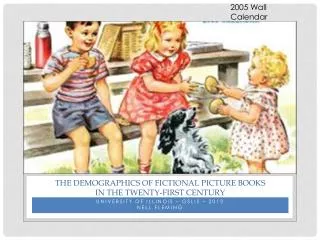
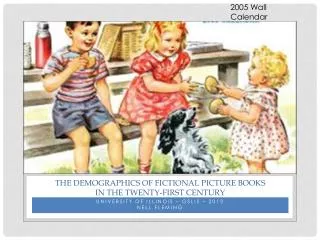
2005 Wall Calendar The demographics of fictional picture booksIn the Twenty-First Century University of Illinois – GSLIS – 2013 Nell Fleming
Nell Fleming Librarian, Mother, Wife, child of the 70’s
An Imbalance Exists in fictional picture books with white faces being depicted 80% or more of the time. Minority-Status Children under the age of 5 make up 50% of the population as of 2012.
The majority of fictional books with black faces on the cover are historical in nature. Books like these are not written for enjoyment
Clip-Clop Eleanor klodofsky
At a Fancy Restaurant Claire st.ong
It’s MY School! Sally grindley
Kindergarten Rocks! Katie Davis
Jack’s Boat Sarah mcmenemy
Mac and the Messmaker Iris Hudson
Am I a color too? By Heidi Cole For every 10 Fictional Picture books, two show minority-Status Students
Victricia malicia: Book loving buccaneer Carrie clickard
Faster, faster! Leslie Patricelli
Angel Coming Henson, Heather
The Garden Wall Tildes, Phyllis Limbacher
GiGI: God’s Little Princess Walsh, Sheila
Girl Vs. Wave Bass, Scott
My Very Own LightHouse Francisco, Cunha
A Pioneer ABC Mary alice downy
Freedom on the Menu: The Greensboro sit-ins by Carole Boston Weatherford These books were not written for enjoyment
Children are damaged by these patterns • How do you think it feels to be a black child and see these patterns of imagery? • How do you think it feels to be a white child and see these patterns of imagery? • How do you think it feels to be an Asian child and see these patterns of imagery? • How do you think it feels…..
Research questions • Are white males are overrepresented on covers and in illustrations, in children’s [fictional] picture books? YES • Do picture-book collections in school libraries represent the (approximately) 50-50 gender ratio of the larger U.S. society? YES • In holiday-themed books, how frequently are children of color represented on the cover? YES • Are white female children represented in picture books more often red-haired? NO • Would a balanced collection require the same ratio of picture books showing minority-status at the same ratio as population totals for children? How else might a balanced collection be determined and measured? Unable to determine quantitatively
Types of literature consulted • Books about book covers • Books about picture books • Books about Image analysis in picture books • Books about racism in children’s literature • Books about the history of children’s literature • Books about multi-racial families • Books about multi-cultural literature • Multi-cultural literature • Websites of publishers, vendors, authors, and reviewers of multi-cultural literature
Follett Title Wave 2005/2012 • Cover art demographic totals: • Prominent White Male: 212 • Prominent White Female: 208 • Prominent Black Male: 31 • Prominent Black Female: 43 • Prominent Asian Male: 4 • Prominent Asian Female: 12 • Prominent Native American Male: 4 • Prominent Native American Female: 1 • No Prominence 97 • Total 612 • Cover Art demographic totals= 258 • White Males = 100 • White Females = 99 • Black male = 17 (2) • Black Female = 17 (6) • Asian Male = 4 • Asian Female = 2 • Native American/American Indian Male & Female = 0 • Zero Prominence = 11 • Ambiguous and Hidden faces = 8
CCBC in Madison Wisconsin 2005 2012 5,000 3,600 68 by and 119 about African Americans 6 by and 22 about American Indians 83 by and about 76 Asian Pacific Americans • 5,000 Total Books • 2,800 Books Received • 75 by and • 149 about African Americans • 4 by and • 34 about American Indians • 60 by and • 64 about Asian Pacific Americans
Limited themes • White males were not only over-represented but books with their images contained over 80 unique themes. • Black males images were depicted on book covers with a total of only 23 themes not related to race or culture or skin color. • Asian and American Indian Males depicted on book covers contained no themes not related to race or culture.
Why • Publishers don’t publish books about minority – status children in mass and often reject books about middle class minority-status students • Publishers don’t market what they do publish as well • Publishers allow these books to go out of print faster • Vendors don’t always carry the books that are published • Purchasers may see these books as “for” only a small percentage of students • Award winning books with black faces are almost always historical fiction or non-fiction
Applications Librarians in schools and youth services
How will this research impact the field? • Librarians will understand the impact of imagery on children’s identity development • Librarians will learn to see balance in terms of collection development in a whole new light • Librarians will have the tools to evaluate and manage their collections for future generations
What will I do differently • Refer others to my research • Collect data section by section in my current library and relate it to my research. Correct deficiencies while simultaneously reaching other goals that my administrators will support. • Continue to find ways to receive feedback from professionals, parents and students of diverse backgrounds to assist in making acquisition recommendations. • Continue to advocate for more diverse staff and volunteers in the library when applicable.
How will others apply the research to their work • First they have to be aware of the work so getting the published paper in the system and sending links to relevant library blogs, journals and websites will be key • Second, they have to read the work so getting some smaller articles written and smaller blog postings about portions of the work may be key because most people don’t read a full thesis. • Third, I believe most librarians want balanced collections, and so whatever portions of the information resonates with them I believe they will start to see patterns themselves.
Weakness’s and limitations • Bias and strong beliefs • Emotional subjectivity • Working in an environment that is unique • The “things will get better” culture of our society • Fear of overcompensating in collection development due to personal bias
Thank you Nell Fleming