El Nino Teleconnections
180 likes | 339 Views
El Nino Teleconnections. Philip Kreycik EPS 131 4/30/04. El Niño - What it is. Periodic anomaly in climate conditions Irregular period Centered in Tropical Pacific Local SST changes, surface pressure change Local and Global consequences South American floods African droughts


El Nino Teleconnections
E N D
Presentation Transcript
El Nino Teleconnections Philip Kreycik EPS 131 4/30/04
El Niño - What it is • Periodic anomaly in climate conditions • Irregular period • Centered in Tropical Pacific • Local SST changes, surface pressure change • Local and Global consequences • South American floods • African droughts • North American rains
’97-’98 El Niño Beginning to Peak Fig. From JPL
Walker Circulation Fig. From the Australian Bureau of Meteorology
El Niño- what causes it • We’re still uncertain • Atmosphere is a chaotic system • Difficult to sort out causes and effects • Pressure seems to be the driving force • Slackening of trade winds impacts temp. profile in ocean • But what causes changes in the trans-Pacific pressure gradient?
Attempts to Predict and Prepare Fig. From Natl. Geographic online
Southern Oscillation Index (SOI) • Oscillation in pressure difference across tropical Pacific • Normalized to the average difference • + means La Nina • - means El Niño
Teleconnections- Floods • Deep Convection- the mechanism • NW Peruvian Coast • Sechura Desert • Southern Brazil • Europe • Implications for human health • Food resources • Disease
Teleconnections- Drought • Shifting Walker Circulation shifting wet and dry areas • Africa, India, Polynesia, Australia, New Zealand Photo from the Royal Society of New Zealand
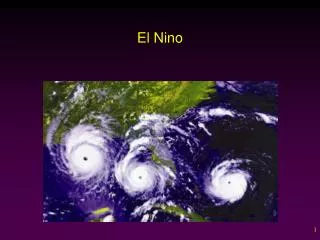
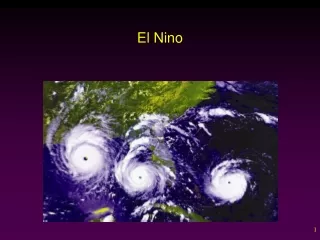
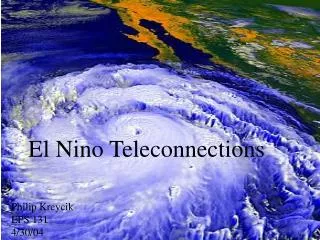
North American Teleconnections “Hurricane Linda, spawned during an El Niño, churns northeastward in September 1997. Linda’s 185-mile-an-hour [298-kilometer-an-hour] winds made it one of the strongest eastern Pacific storms ever recorded” Photo and caption from Natl. Geographic
Teleconnections- N. American Storms and Rain Fig. from the NOAA
North American Monsoon • Christopher Castro et al. “The Relationship of the N. Am. Monsoon to Tropical and N. Pacific SST as Revealed by Observational Analyses” • Highly variable period of wet weather • Short bursts of intense precipitation
Western US Sensitivity to ENSO • Not as simple as the NOAA diagram makes it seem! • Dependence on several oscillating systems • ENSO • NPO • Others • Relative phases
ENSO and the N. Pacific Oscillation • NPO high, El Nino phaseconstructive interference • cold central Pacific, warm East Pacific • Strong effect on N. Am. monsoon • NPO low, El Nino phasedestructive interference
Final conclusion of the study • Moisture drawn in from Gulf of Mexico • Low pressure displaced to lower lat. in El Nino • Circulation around pressure system • Predictive power still leaves something to be desired