Download
1 / 12
130 likes | 252 Views
This guide explores how to determine the velocity of a point on one tectonic plate with respect to another. By analyzing the angular velocity and coordinates of different plates, we can find relative velocities in terms of North-South, East-West, and vertical components. Utilizing a function in MATLAB, users will learn to compute and visualize velocities using latitude and longitude data, including practical examples like calculating the velocity of Mauritania relative to the North American plate.

E N D
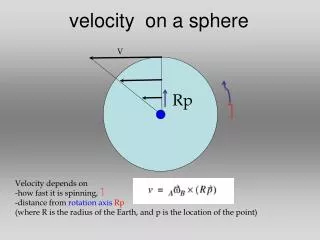
velocity on a sphere V Rp ω Velocity depends on -how fast it is spinning,ω -distance from rotation axis Rp (where R is the radius of the Earth, and p is the location of the point)
The North American plate is rotating about the blue triangle Velocity at a point depends on -how fast it is spinning,ω -distance from the point to the rotation axis R
We’ll be finding relative velocities of a point on one plate with respect to another plate Ex: What is the velocity of Mauritania relative to the NA plate? Mauritania
What is the velocity of Mauritania relative to the NA plate? Table 1 gives us the plate rotation vectors (the angular velocity and the lat long of the Euler pole) We want velocities in terms of N-S, E-W, up-down: Ex: Avpb=0.5 cm/yr north + 2.0 cm/yr east need to do some conversions: Know lat (λ) and long (Φ) of point Want to get x, y, zcoord. Mauritania
z-> north pole y-> 90° East longitude Know lat (λ) and long (Φ) of point Want to get x, y, z coordinates X-> 0° longitude Mauritania
Which gives us velocity in x,y,z space But, want local geographic coord. Now we have the coordinates of p Can get velocity Mauritania
But, want local geographic coord. (N-S, E-W, up-down) Mauritania
Now have velocity in terms of North, East, and up-down Ex:Avpb=0.5 cm/yr north + 2.0 cm/yr east Can also determine magnitude and direction of relative velocity Ex. 45 mm/yr 102° SE Mauritania
Today’s lab • Functions vs scripts • Today you’ll be making functions- a function is slightly fancier than a script. • A function can be run from the command line, with input and output variables • Today you will be writing a function to compute the relative velocity of a point on one plate with respect to another plate
Today’s lab • plate_vel.m will be a function • The first line of your code will declare thatplate_velis a function • Function vl=plate_vel(lat, lon, latp, lonp, omega) • v1 will be the output (the velocity of the point) • (lat, lon, latp, lonp, omega) will be the input (the location of the point, location of the euler pole, and the rotational velocity • So, once you have written and saved the function, you can go to the command line and and get the velocity of a point relative to another plate
Today’s lab • To find the velocity of a point on the Pacific plate (at lat=37° and long=-123°) relative to North America by look up the rotation vector in table 1 (48.7, -78.2, 0.78) and type • Vl=plate_vel(37, -123, 48.7, -78.2, 0.78) • Matlab will return Which are the N-S E-W up-down Components of the velocity
Note error in table: • Nazca-Pacific… longitude of Euler pole is -90.1 E