Download
1 / 16
180 likes | 331 Views
This text explores the fundamentals of triangle congruence, specifically focusing on the congruence statement ΔABC ≅ ΔVPI. It outlines the different criteria for triangle congruence: SSS, SAS, ASA, AAS, and HL. Understanding these principles allows us to identify corresponding parts of triangles, known by the acronym CPCTC (Corresponding Parts of Congruent Triangles are Congruent). The document also engages readers in practice problems to apply their knowledge of triangle congruence in geometric proofs.

E N D
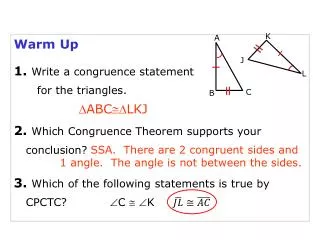
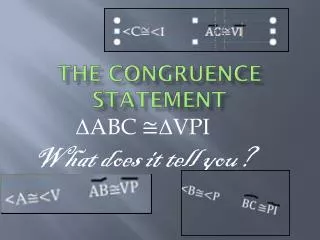
The Congruence Statement ΔABC ≅ΔVPI What does it tell you?
1, 2, 3, 4, 5, SIX! • If the triangles are congruent by SSS, SAS,ASA, AAS, or HL, then three pairs of corresponding parts have been used. • Remember, there are six corresponding parts!
Consider the next proof.., • List off the six corresponding parts. • Check the ones that are used to prove the triangles are congruent. • See the left - overs. • These may be used as congruent by the Definition of Congruent Triangles.
This book uses the expression: • Corresponding Parts of Congruent Triangles are Congruent. • CPCTC
CPCTCstands for… • With SSS, SAS, ASA, and AAS, you know how to use 3 parts of triangles to show that the triangles are congruent. • Once you have triangles congruent you can make conclusions about their other parts because, by definition, corresponding parts of congruent triangles are congruent. CorrespondingParts of CongruentTriangles are Congruent
Given: andProve: XMQ RMT StatementsReasons 1. 1. Given 2. 2. 3. 3. 4. 4. Def. of segment bisector 5. XMQ RMT5.
Changing the goal… • No longer is the goal to prove the triangles are congruent… • Now we want the PARTS!
Given: andProve: StatementsReasons 1. 1. Given 2. 2. 3. 3. 4. 4. Def. of segment bisector 5. 6. 5.XMQ RMT5.
Changing the goal Prove: 8.