The Influence of Geography and Philosophical Thought on Ancient Greek Civilization
120 likes | 230 Views
Ancient Greece's geography significantly shaped its civilization, with sea travel connecting it to other societies, while mountain ranges divided the land, influencing political life. The Mycenaean and Minoan cultures laid the foundations of Greek religion, trade, and art. Major events like the Trojan War exemplify Greek myth and history. The Dorian period saw the rise of myths narrating human emotions. Philosophers like Socrates, Plato, and Aristotle advanced thoughts on truth and governance, establishing foundational concepts that continue to impact our understanding of philosophy and science today.


The Influence of Geography and Philosophical Thought on Ancient Greek Civilization
E N D
Presentation Transcript
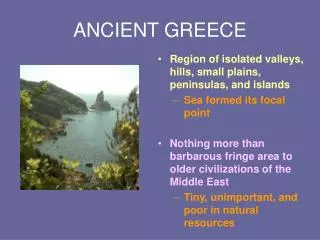
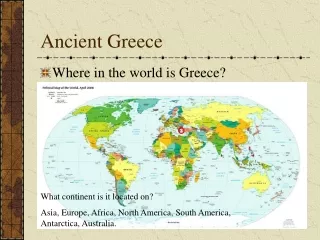
Geography • The Sea: Shaped Greek civilizations • Sea travel connected Greece with other societies. • Greece lacked natural resources • Timber, Precious metals, usable farmland. • The Land: Mountains divided the land. • Influenced Greek political life. • Small parts suitable for farming. • The Climate: 48(lows) 80(high) • Much time at outdoor public events.
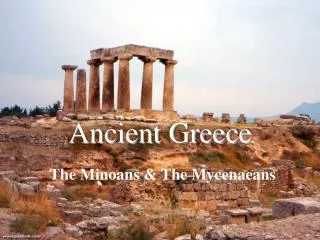
Mycenaean's • Came from Indo-European migrants • Borrowed from Minoan culture • Seaborne trade. • Adopted the Minoan writing system. • Formed the core of Greek religious practices, art, politics, and literature
Trojan War • Independent trading city in Anatolia. • Trojan prince kidnapped Helen (wife of a Greek King). • One of the last Mycenaean battle campaigns. • http://www.youtube.com/watch?v=MsOb86jqN04
Minoans • Used ships to trade goods • Had a writing system • Influence in culture.
Greek Culture under the Dorian's • No advanced writing system • Myths: Traditional stories about their gods • Human qualities: love, hate, and Jealousy • Epics of Homer= Learned their history through spoken word. • Narrative poems celebrating heroic deeds. • The Iliad
We Are Sparta! • http://www.youtube.com/watch?v=qubItQjdSHA • Sparta Builds a military state. • Sparta dominates Myceneans • Society • Daily Life
Philosophers Search for Truth • Philosophers = lovers of wisdom • Based philosophy on: • The universe( land, sky, and sea) is put together in an orderly way and subject to absolute and unchanging laws. • People can understand these laws through logic and reasoning
Socrates • Absolute standards exist through truth and justice. • Greeks should question themselves and their moral character. • Encouraged his students to examine their beliefs. By asking them a series of leading questions. • Socratic method = question and answer approach
Plato • Student of Socrates • The Republic, set forth his vision of a perfectly governed society= not a democracy • All citizens would fall naturally into three groups: Farmers/artisans, warriors, and the ruling class. (greatest insight will be king). • School in Athens called the Academy
Aristotle • Questioned the nature of the world and of human belief, thought, and knowledge. • Method of arguing according to logic= provides basis of scientific method used today. • Alexander the Great’s tutor.