Download
1 / 8
80 likes | 246 Views
This guide explores the fundamental concepts of linear measurement in geometry, focusing on line segments, betweenness of points, and congruent segments. A line segment can be measured as it has defined endpoints, unlike a line. We discuss methods for constructing geometric figures without measuring tools and provide practical examples for measuring and calculating segment lengths. Additionally, we practice identifying congruence among segments and solving equations involving segment measures, reinforcing comprehension through varied practice problems.

E N D
Vocabulary • Line Segment- unlike a line, a segment can be measured because it has 2 endpoints • Betweenness of points- There is always a point that lies between two other points on any line • Congruent Segments- segments that have the same measure • Constructions- methods of creating geometric figures without the benefit or measuring tools
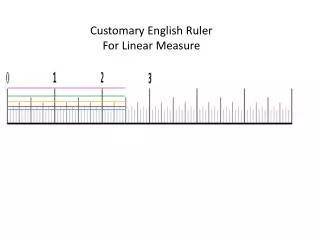
Examples 1 and 11/16 inches 4 and 1/5 cm
Examples • Find the measure of each segment: 18.4 + 4.7 = 23.1 cm 100 - 89.6 = 10.4 cm
Practice 5 ½ cm 2 ¼ in
Practice 1 + 1 ¼ = 2 ¼ in 4.9 + 5.2 = 10.1 cm 15 – 9.7 = 5.3 mm
Examples K J L • 6. JK = 6x , KL = 3x , JL = 27 • 7. Are the following congruent? JK + KL = JL 6x +3x = 27 9x = 27 x = 3 Yes, because of the single tic marks on each segment
Practice K J L • 6. JK = 2x, KL = x+2 , JL = 5x-10 • 7. Are the following congruent? JK + KL = JL 2x +x+2 = 5x-10 3x + 2= 5x – 10 12 = 2x 6 = x No, TU is 2 ft, SW is 3 ft