Personal Fall Detection Device
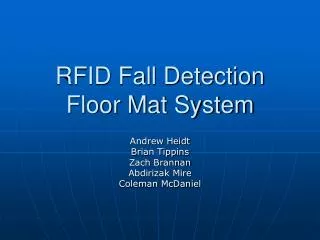
The Personal Fall Detection Device (PFDD) project, developed by students at the Georgia Institute of Technology, addresses the critical issue of accidental deaths due to falls among the elderly. This automation-driven system consists of interconnecting devices designed to detect falls and provide immediate assistance without requiring the user to press a button. The lightweight transmitter can be worn around the neck or ankle, and the system automatically contacts emergency services, ensuring safety for individuals aged 75 and older living alone. Estimated development costs are $150, with no monthly fees for users.

Personal Fall Detection Device
E N D
Presentation Transcript
Personal Fall Detection Device Georgia Institute of Technology School of Electrical and Computer Engineering Jonathan Annua, Mason Edwards, Matthew Jue, Terry Sharp, Joshua Whittle October 19-23, 2009
Project Overview Falls are responsible for 70% of accidental death in persons aged 75+ • PFDD is automated system of interconnecting devices to detect user falls • Primary client elderly people living alone. May need help if they fall • Current devices on market require user to press a button to gain help • Estimated development cost $150 • No monthly fee. Presented By: Matthew
Design Goals • Transmitter Package • Fits around neck or ankle • Weight: under one pound • Covers average-size house • Battery life of six months • Receiver Package • Automatically calls emergency service • Prevents “false falls” • Low maintenance Presented By: Matthew
Design Approach - Interface Presented By: Jonathan
Design Approach – Component Diagram Doorbell transmitter Battery Tilt switch Pressure switch Doorbell receiver PIC Automatic phone dialer Emergency contact number Presented By: Jonathan
Design Approach - States Presented By: Jonathan
Project Demonstration • Demo consists of • Setup • Trial process Presented By: Terry
Setup • In dorm room • Student wears PFDD • Pressure sensor connected to bed • Cell phone receives call • Safety mat for student Presented By: Terry
Trial 1 Trial 2 Student in bed Student in bed Student off bed Student off bed Student fall Student in bed Cell phone ring Trial Process Presented By: Terry
Cost Analysis Presented By: Mason
Detecting Bed Pressure Presented By: Mason
Transmitter Battery Life • Transmitter continuously transmits when in bed Possible solutions • Create one-shot circuit for pushbutton and tilt switch • Add repeat circuit with one-shot timer • Modify power supply Presented By: Mason
Chime Output • Output from chime is AC, needs 2-5V DC for PIC Possible solution • Full-wave rectifier built with 5 V regulator Presented By: Joshua
Schedule • Getting parts – 10/29/2009 • Prototyping – 10/20/2009 • Trouble shooting – 11/2/2009 • Soldering parts – 11/9/2009 • Project demonstration – 11/16/2009 • Writing final summary – 11/21/2009 Presented By: Joshua
Current Status • Waiting for final parts • Putting parts together • Deciding on pressure sensor Presented By: Joshua
30% of elderly persons fall each year. Did you know?