
Understanding the Dispersion of Light: Color Spectrum and Primary Colors
This chapter explores the dispersion of sunlight through a prism, separating it into seven distinct colors: red, orange, yellow, green, blue, indigo, and violet. It introduces the concept of the visible light spectrum, which ranges from approximately 400nm to 700nm, highlighting the properties of color perception based on light absorption and reflection. Additionally, the chapter discusses the primary colors of light (red, green, blue) and pigment (magenta, cyan, yellow), illustrating their mixtures and effects on color appearance.

Understanding the Dispersion of Light: Color Spectrum and Primary Colors
E N D
Presentation Transcript
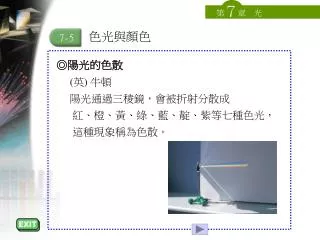
第7章 光 色光與顏色 7-5 ◎陽光的色散 (英) 牛頓 陽光通過三稜鏡,會被折射分散成 紅、橙、黃、綠、藍、靛、紫等七種色光, 這種現象稱為色散。
第7章 光 ◎可見光 1.連續排列的可見光色光帶,稱為可見光譜。 2.可見光是電磁波,波長範圍 約在400nm~700nm間。 3.其中紅光的波長最長,而紫 光的波長最短。
第7章 光 4.物體所顯現的顏色,與表面吸收與反射光 的特性有關。 5.黑色物體能將所有入射的色光吸收, 故呈黑色。 6.所有色光發生反射,混合進入眼睛, 所看到的顏色即是白色。 7.白光光源透過具顏色的透明物質, 可放射不同色光。
第7章 光 ◎光的三原色 1.紅、綠、藍,為光的三原色。 2.三原色光以不同的亮度混合,即可呈現 許多不同的顏色。 3.將三原色光重疊照射,顯現白色。 4.物體所呈現的顏色, 與照射光源的顏色、 物體表面吸收以及 反射光的特性有關。
第7章 光 ◎顏料三原色 1.顏料三原色為洋紅色、青色及黃色。 2.當顏料三原色以等量混合時, 會呈現近乎黑色。 顏料三原色 顏料三原色 光的三原色