Audio Basics - Propagation, Amplitude, Frequency & Timbre
80 likes | 89 Views
Music Production


Audio Basics - Propagation, Amplitude, Frequency & Timbre
E N D
Presentation Transcript
Audio Basics: Propagation, Amplitude, Frequency and Timber Maths Dx [Best viewed in Powerpoint Slide Show]
Audio Basics Hi, I’m Maths Dx from a far away galaxy on the Internet. This lesson is for Week 1 of Introduction to Music Production at Coursera.org. Today, I will be covering the basics of audio as concisely as possible. The way to approach this lesson is that it presents all the salient points of the topic and is an easy-reference for later use also. Introduction • All of these principles of sound – Propagation, Amplitude, Frequency/ Timbre are completely independent of each other and the the following slides will explain the basics of sound • We will show that the basic properties of sound that allow it to be utilized in a wide variety of ways can manifest in some of the following audio effects as they each impact respective parts of the sound • Propagation • delay, reverbs • Amplitude • Compressors, expanders, gates, limiters • Frequency/ Timber • EQ, filters *English functionalities to be added in Phase 3
1. Propagation • Is the movement of sound through a medium • Sound can go through a variety of mediums – air, water, metal etc at different speeds • There are many properties of air that can change the rate of sound, for example: • Temperature, • Humidity • Elevation eg. sea level or on an elevated place like Denver • Specifically speaking, one can define the speed of sound at a specific temperature or at sea level but generally speaking, these factors only change speed of sound a little and we generally say that sound travels at: • 340 m/sec • 1ft/msec • 1km/ 3 sec • 1 mille/ 5 sec • Sound effects like delay, reverb, phasers and flangers are all related to the idea of propagation • For example when one sings in a room or studio, all the surfaces around are reflecting the sound at different speeds or propagating differently and reaching the ear or microphone at different times • So what we do in a mix is creating a sense of space and depth based on an idea of propagation
2. Amplitude Definition • Amplitude is how much the air is compressed or rarefied as a sound waveform moves or propagates through the air It’s a measure of the amount of energy in a sound wave • However, Longitudinal and Transverse waves are both shown in diagrams as Transverse waves • A sound wave vibrates differently in the air compared to materials with respect to the direction of propagation. Air – Longitudinal (parallel to propagation) Propagation Direction Guitar String – Transverse (perpendicular to propagation) *English functionalities to be added in Phase 3
2. Amplitude (cont’d) Measurement • Amplitude is measured in decibels • There are numerous places in the signal flow that it is measured, and it is to be noted that it is a relative measure with no definite set point where 0 is with different uses based on context • In the air, it is decibels of Sound Pressure Level: DBSPL • The SPL portion is related to the threshold of hearing setting where zero is or the quietest thing we can hear in the air • In the digital domain (eg computer), it is DBSFS (Full Scale) • This is related to the loudest thing that can be represented in numbers within the computer. • Zero represents the loudest possible thing that can be represented in the computer and it goes negative from there • Negative dB in the computer, Positive dB for sound in the air • Amplitude is a measurable thing in the computer whereas loudness is the human perception of amplitude • Amplitude in producing mxing is a primary area • In Mixing, for tracks to be relative to each other • Panning • Plugins controlling amplitude of the signal over time: • Expanders, Gates, Compressors, Limiters
2. Amplitude (cont’d) Dynamic Range • Amplitude is relevant in audio gear eg. microphones • Dynamic range of a piece of gear is the range level between the noise floor or the quietest and the distortion when it gets too loud to be reproduced. • Also used to describe a piece of music from its quietest to its loudest
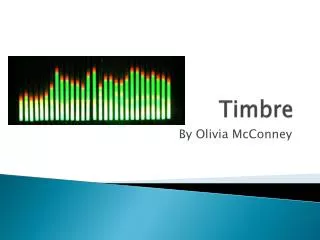
3. Frequency/ Timbre • Frequency is related to how fast the sound wave is is vibrating • Timbre is the collection of sounds at multiple frequencies • Every instrument has energy at multiple frequencies - also called harmonics or partials or overtones, which describes the timbre or the spectrum • Only the simplest of sound has energy at a single frequency – which is a sine wave, which rarely occurs naturally • The normal range of hearing for humans is between 20 Hertz to 20,000 Hertz (Hz) where 1 Hz = once per second • Children can usually hear frequencies across the whole spectrum whereas adults upper reach is around 18 kHz. • We don’t hear equally across the whole range with our hearing level dissipating at both ends, and variations in the middle frequencies – this frequency response rate of our ears is also a feature of gear like microphones etc *English functionalities to be added in Phase 3
Epilogue Though it is a dry topic, I hope that this presentaiton will help you relate it to the effects you use to produce music. The basics in audio described will be building blocks to music production. *English functionalities to be added in Phase 3
![G3 - RADIO WAVE PROPAGATION [3 Exam Questions -- 3 Groups]](https://cdn0.slideserve.com/819386/g3-radio-wave-propagation-3-exam-questions-3-groups-dt.jpg)