Understanding Solubility Equilibria: Lead(II) Iodide Precipitation and Common Ion Effects
This article explores solubility equilibria, focusing on the precipitation of Lead(II) iodide when potassium iodide is mixed with lead(II) nitrate. It discusses the solubility product constant (Ksp) values for selected salts and provides a step-by-step guide on predicting precipitate formation using the reaction quotient (Qsp). Additionally, it explains the concept of common ions and their effect on solubility, specifically how the presence of ions in solution can lower the solubility of certain salts, illustrated with practical examples like AgI and PbCrO4.

Understanding Solubility Equilibria: Lead(II) Iodide Precipitation and Common Ion Effects
E N D
Presentation Transcript
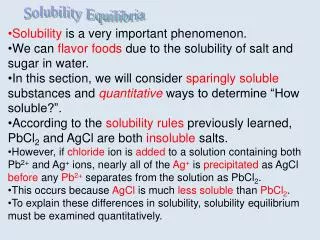
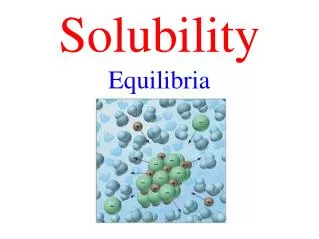
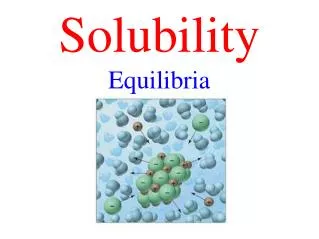
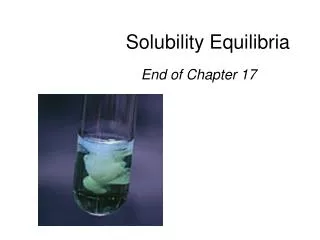
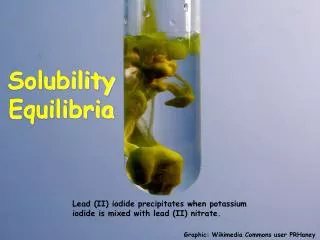
SolubilityEquilibria Lead (II) iodide precipitates when potassium iodide is mixed with lead (II) nitrate. Graphic: Wikimedia Commons user PRHaney
Solving Solubility Problems For the salt AgI at 25C, Ksp = 1.5 x 10⁻¹⁶ AgI(s) Ag+(aq) + I-(aq) O O +x +x x x 1.5 x 10-16 = x2 x = solubility of AgI in mol/L = 1.2 x 10⁻⁸ M
Solving Solubility Problems For the salt PbCl2 at 25C, Ksp = 1.6 x 10⁻⁵ PbCl2(s) Pb2+(aq) + 2Cl-(aq) O O +2x +x 2x x 1.6 x 10-5 = (x)(2x)2 = 4x3 x = solubility of PbCl2 in mol/L = 1.6 x 10⁻² M
Solving Solubility Problems For the salt AgI at 25C, Ksp = 1.5 x 10⁻¹⁶ AgI(s) Ag+(aq) + I-(aq) O O +x +x x x 1.5 x 10-16 = x2 x = solubility of AgI in mol/L = 1.2 x 10⁻⁸ M
Predicting Precipitate Formation • Use the initial concentrations of ions in solution in the solubility product constant expression to calculate Qsp. • If Qsp < Kspthe solution is unsaturated and no precipitate will form. • If Qsp = Kspthe solution is saturated and no change will occur.
Predicting Precipitate Formation, continued… • If Qsp > Kspa precipitate will form, reducing the concentrations of the ions in the solution until the product of their concentrations in the Ksp expression equals the numerical value of Ksp.
Predicting Precipitate Formation, continued… Do practice problems on pg. 619
Predicting Precipitate Formation, continued… Answers: 25. a. Qsp > Ksp so a precipitate of PbF2 will form. b. Qsp < Ksp so no precipitate will form 26. A precipitate will form.
The Common Ion Effect • Why is PbCrO4 less soluble in aqueous solution of K2CrO4 than in pure water? • The K2CrO4 solution contains CrO42– ions before any PbCrO4 dissolves.
The Common Ion Effect (cont.) • A common ion is an ion that is common to two or more ionic compounds. • The lowering of the solubility of a substance because of the presence of a common ion is called the common ion effect.
Solving Solubility with a Common Ion For the salt AgI at 25C, Ksp = 1.5 x 10⁻¹⁶ What is its solubility in 0.05 M NaI? AgI(s) Ag+(aq) + I-(aq) 0.05 O 0.05+x +x 0.05+x x 1.5 x 10-16 = (x)(0.05+x) (x)(0.05) x = solubility of AgI in mol/L = 3.0 x 10⁻¹⁵ M