Download

1 / 2
0 likes | 20 Views
Discover the inner workings of hydraulic cylinders. Learn how these essential components operate, their key parts, and their applications in various industries.

E N D
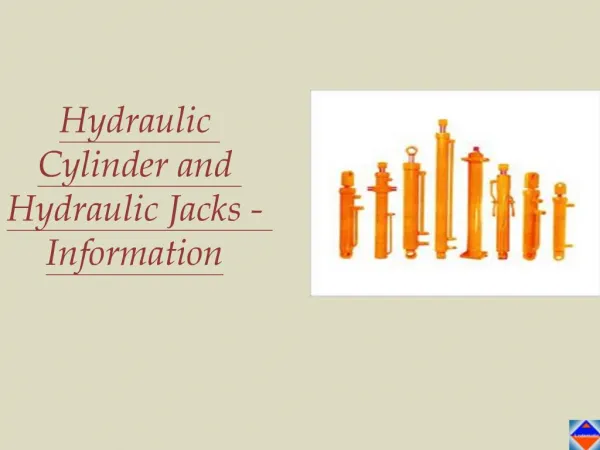
How Does a Hydraulic Cylinder Work? Hydraulic cylinders are essential components in many machines, transforming hydraulic energy into mechanical force. Understanding how they work provides insight into the broader field of hydraulics, a key area in modern engineering. This article delves into the mechanics, components, and applications of hydraulic cylinders, shedding light on their critical role in various industries. What is a Hydraulic Cylinder? A hydraulic cylinder, also known as a linear hydraulic motor, is a mechanical actuator used to provide unidirectional force through a unidirectional stroke. It is a critical part of hydraulic systems used in various industrial, construction, and manufacturing applications. Key Components of a Hydraulic Cylinder 1. Cylinder Barrel: The main body of the cylinder, which houses the piston and holds the hydraulic fluid. 2. Piston: A cylindrical component that moves within the barrel, creating pressure differentials that generate force. 3. Piston Rod: Connected to the piston, this rod extends from the cylinder to transfer the generated force to the desired location. 4. Cylinder Head: Also known as the end cap, it seals the cylinder's ends, preventing hydraulic fluid from leaking. 5. Cylinder Base: The other end cap that also prevents fluid leakage and can sometimes serve as a mounting point. 6. Seals: Essential for preventing leaks and maintaining pressure within the cylinder. 7. Hydraulic Fluid: The medium through which force is transmitted within the cylinder. How Does a Hydraulic Cylinder Work? The operation of a hydraulic cylinder is based on Pascal's Law, which states that pressure applied to a confined fluid is transmitted equally in all directions. Here's a step- by-step breakdown of how a hydraulic cylinder works: 1. Pressurization: Hydraulic fluid is pumped into the cylinder through an input port. The fluid enters the chamber and builds up pressure. 2. Piston Movement: The pressurized fluid forces the piston to move along the cylinder barrel. The direction of the piston's movement depends on where the fluid is entering and exiting the cylinder.
3. Extension and Retraction: When fluid is pumped into the bottom chamber (cap end) of the cylinder, the piston rod extends. Conversely, when fluid is pumped into the top chamber (rod end), the piston rod retracts. 4. Force Transmission: The piston rod transfers the force generated by the hydraulic pressure to the machine's load or component that needs to be moved. Types of Hydraulic Cylinders Hydraulic cylinders come in various types, each suited for different applications: 1. Single-Acting Cylinders: These cylinders exert force in one direction only, typically extending under hydraulic pressure and retracting under an external force such as a spring. 2. Double-Acting Cylinders: These can exert force in both extending and retracting directions by alternating the flow of hydraulic fluid between the two chambers. 3. Telescopic Cylinders: These consist of multiple nested stages that extend sequentially, providing a long stroke from a compact initial length. Applications of Hydraulic Cylinders Hydraulic cylinders are widely used across various industries due to their ability to generate significant force and precise control. Common applications include: Construction Equipment: Excavators, bulldozers, and cranes rely on hydraulic cylinders for lifting and moving heavy loads. Manufacturing Machinery: Presses, injection molding machines, and material handling systems use hydraulic cylinders for precise movements and force application. Automotive: Hydraulic cylinders are used in braking systems, suspension systems, and power steering mechanisms. Aerospace: Aircraft landing gear and control systems often employ hydraulic cylinders for reliable and powerful actuation. Conclusion Hydraulic cylinders are indispensable in modern engineering, providing powerful and precise actuation in countless applications. By converting hydraulic energy into mechanical force, they play a vital role in various industries, from construction to aerospace. Understanding their components and operation helps in appreciating the ingenuity behind hydraulic systems and their impact on everyday machinery and technology.