Nutritional Strategies for Preventing Developmental Orthopedic Disease in Horses
70 likes | 188 Views
Developmental Orthopedic Disease (DOD) poses a significant threat to the health of growing horses, leading to bone and joint disorders such as fetlock, knee, and hock deformities. Key nutritional factors contributing to DOD include rapid growth rates, excessive energy intake, mineral imbalances, and improper feeding practices. Maintaining a proper calcium to phosphorus ratio (2:1 for adults and 3:1 for growing horses) is essential. Deficiencies or imbalances in minerals like copper and zinc can exacerbate these issues, highlighting the importance of a well-rounded diet for optimal bone health.


Nutritional Strategies for Preventing Developmental Orthopedic Disease in Horses
E N D
Presentation Transcript
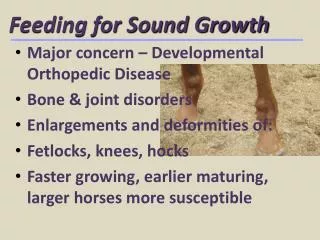
Feeding for Sound Growth • Major concern – Developmental Orthopedic Disease • Bone & joint disorders • Enlargements and deformities of: • Fetlocks, knees, hocks • Faster growing, earlier maturing, larger horses more susceptible
Nutritional Causes of DOD • 1. Fast growth rate, large body size • 2. Excess energy intake • 3. Slow growth followed by rapid growth • 4. Mineral imbalances • Low Ca, Low P, High P • Low Cu, Low Zn
Feeding Practices that Cause DOD • Grain inadequate in P, Cu, Zn when feeding alfalfa • Grain inadequate in lysine, Ca, P, Ca, Zn when feeding grass hay • Excessive amount grain • Over-feeding young horses in poor condition
Ca & P • Ratio important – 2:1 in diet • Adults < 6:1, growing < 3:1 • Bran – low Ca, high P (1:13) • Grains – low Ca, high P (1:5 to 1:10) • Hays – high Ca, low P (5:1 to 1.5:1)
Ca & P • Deficiency Ca and/or P can cause bone mobilization, developmental orthopedic disease • High P – interferes with Ca • High Ca – interferes with P, Zn
Cu & Zn • Critical for normal bone growth • Cu and/or Zn deficiency = DOD • Cu excess = death • Zn excess = Cu deficiency, DOD
Cu & Zn • Growing horses Cu = 150 mg/d or 25 ppm Zn = 450 mg/d or 75 ppm • Adults Cu = 150 mg/d or 15 ppm Zn = 450 mg/d or 45 ppm