Ionic vs Flutter_ Best Platform for Hybrid App Development
E N D
Presentation Transcript
Ionic vs Flutter: Best Platform for Hybrid App Development Being part of a world increasingly working on mobile devices, it has become imperative for companies to have performant cross-platform
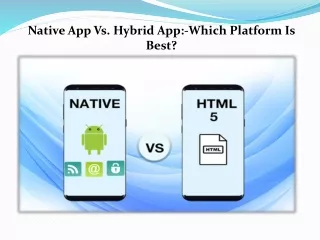
2 mobile apps that work seamlessly on all operating systems and cater to a more significant share of the customer base. When it comes to cross-platform mobile apps, the two leading frameworks used in the modern-day tech realm to build high-performing cross-platform apps are Ionic and Flutter. Both frameworks are inherently different, despite having the common goal of developing high-performing mobile apps. And if you think there will be many similarities between the working process of the leading cross-platform app development frameworks, you are highly mistaken. For any enterprise, deciding which one is best for their project can be tricky. Thus, this article will try to understand and conclude the debate between Flutter and the Ionic framework to help enterprises decide the best mobile app development framework for their business requirements.
3 Flutter: An Overview Do you know, according to the 2021 developer survey, Flutter is the most popular cross-platform mobile framework, and 42 percent of software developers use Flutter for hybrid mobile app development. Google’s brainchild – Flutter, is a relatively scalable and fast cross-platform framework that primarily functions as a UI toolkit to create feature-rich and powerful cross-platform applications. Developed in 2017, the first version of Flutter was released in 2018 with the support of the ECMA standard.
4 Empowered with an intuitive interface, a library of elements, and many templates, Flutter support Dart programming language, utilizes Swift and Objective C for iOS integration and Java for Android. The framework’s thriving user community with open-source libraries, resources, and answers to all programming dilemmas is what sets Flutter framework apart from the rest of mobile app development frameworks. Advantages of Flutter While comparing Flutter vs. Ionic, Flutter has many decent selling points, including: ● Hot-reload — One of the unique features of Flutter is Hot Reload. The changes are visible as soon as the flutter app developer or designer updates the code. ● Rich & Powerful Widgets — Combined with RichWidgets, the Flutter framework equips mobile app developers with an extensive library to add rich, layered functionalities in apps compatible with any operating system. ● Flawless back-end integration — Whether the backend is in Java supporting Android or Objective C or Swift
5 supporting iOS, Flutter integrates smoothly enough to make the frontend look as native as the backend. ● Quick iteration — Flutter offers swift iteration cycles that save coding and quality control hours as testing is needed for one codebase only. Disadvantages of Flutter It is always advised to remember that every tool or technology has its definite downsides. They may or may not affect the flutter app development for your business. But here are some common disadvantages you may experience: ● Immaturity of the platform — Compared to Ionic, Flutter is competitively a new platform launched less than three years ago; therefore, one major downside of using flutter for hybrid mobile app development is the lack of community-generated tools and libraries. ● Rendering issues — Another downside of flutter app development that comes into consideration is the plug-ins rendering issues if you’re using vectored or moving images while developing a hybrid mobile app.
6 ● Platform compatibility — While Flutter offers cross-platform interoperability, apps like tvOS, Android Auto, CarPlay and watchOS won’t function flawlessly. ● Updating roadblocks — Flutter makes you work through its processes every time to post system changes. When to use Flutter Framework for Hybrid Mobile Application Development Flutter can be used for the following purposes: ● Developing Minimally Viable Product (MVPs), utilizing Flutter’s light construction to make speedy first edition or proof of concept apps ● Building apps using material design language ● Building Apps having Simple Logic OS Plugins ● High-performance apps featuring Skia rendering engine ● Flexible UI that use brilliant code-dense widgets ● Reactive apps with heavy data integration and user interaction Also Read: Flutter App Development: Common FAQs Answered
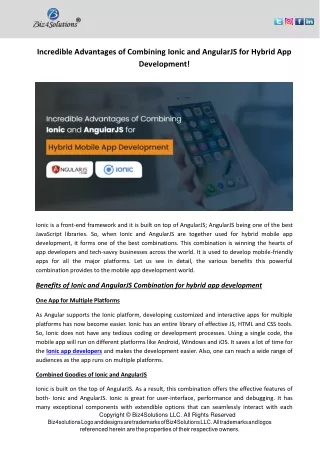
7 Ionic: An Overview Do you know, Currently, there are more than 5 million apps built on Ionic available in the market. And approximately 86% of developers prefer using Ionic. The first version of Ionic came into existence in 2013 when three coders named Max Lynch, Adam Bradley and Ben Sperry built an open-source UI toolkit on AngularJS. On 25th July 2019, the latest yet stable version of the Ionic cross-platform app development framework was released, and since then, Ionic has become one of the most popular cross-platform app development frameworks known for providing efficient performance with minimum DOM manipulation. To define, Ionic is a well-integrated, open-source framework and UI toolkit used to build high-performing desktop & mobile applications with well-known languages like HTML, CSS, React Native, Angular, Vue.JS and JavaScript for integration with your backend. The Ionic framework primarily targets to improve the frontend user experience by equipping hybrid app developers with vast libraries of mobile-optimized UI components, tools and gestures to build future-ready mobile apps that reciprocate impact and increase customer engagement.
8 Advantages of Ionic Ionic is the only framework that allows developers to create a single, simple-to-use JavaScript codebase. In addition, here are a few advantages of using Ionic for cross-platform application development. ● Platform-independence — Being a platform-independent framework, Ionic reduces the time, effort, and resources employed to build a cross-platform app with a native look and feel. ● Simplified developer interface — Ionic uses a capacitor that saves development time and creates an easy-to-use interface to access native API and native SDK on platforms. ● Community Support — Ionic is built on top of popular technologies such as Cordova and Angular and has an active community for support. This makes it easy to access quick responses to queries while developing cross-platform apps. ● Easy Testing — Another advantage of Ionic is mobile app testing. It is easier to test on a desktop browser or perform simulator testing for iOS, and Android apps using Cordova commands with Ionic.
9 ● Scalability — Scales efficiently as the number of active users doesn’t affect its performance. Disadvantages of Ionic Now that we’ve covered some of the significant advantages of the Ionic mobile application development framework, now is the time to look at some of the disadvantages. ● Plugin Dependent System — Ionic offers a plethora of plugins, yet it’s imperative for developers to create some highly-specific features. In simpler words, if you’d like to use another plugin that uses other languages/libraries, you may find yourself trying to version them back over to JavaScript on your own. ● Absence of Hot Reloading — Ionic doesn’t accommodate hot reloading and refreshes the whole app whenever the developer changes, slowing down your development speed. ● Security threats — While this isn’t the case on the newer updates of Ionic, using older versions won’t provide code uglification. ● Performance — Using Ionic to build heavy applications makes the app crawl. Thus it isn’t suitable for
10 memory-intensive or complex applications as Ionic uses WebView to render apps. When to use Ionic Framework for Hybrid Mobile Application Development Ionic can be used to develop: ● Hybrid mobile app development ● MVC mobile apps ● Native wrapper ● Cross-platform mobile application development ● Hardware functionality enabled app ● High-performance UX/UI applications Popular Applications built with Flutter and Ionic The best way to judge Flutter vs. ionic framework is to see the differences between the real-world use cases. Here’s a list of some tech giants who are entrusting Flutter and Ionic to meet their market needs. Popular apps made with Flutter ● Google Ads ● Tencent
11 ● Alibaba ● eBay ● BMW ● Reflectly Popular Apps built with Ionic: ● Nationwide ● Pacifica ● MarketWatch ● JustWatch ● Microsoft Flow Flutter Vs Ionic: Comparison Ionic Parameter Flutter Language(s) HTML, CSS, JavaScript Dart Standard-based web UI elements Proprietary widgets components
12 Native plugin library, Native plugin library, Native API using Cordova and using Flutter native access Capacitor packages Custom graphics Runtime Web browser machine Offline Yes Yes access Mobile Very good Excellent performance Type Software framework Application framework
13 License MIT License New BSD License Hot Reload No Yes Performanc Moderate Amazing controller e Mobile device or Testing Any browser emulator Code 50-90% of code is 98% of code is reusable reusable reusability Typical use Hybrid app MVP applications, Apps cases development, App with with material design, hardware functionality, High-performance apps
14 MVC mobile apps, and with a Skia rendering more engine, and more Deployment Mobile, Desktop, Web, Mobile, Desktop, Web PWA Options Diesel, Sworkit, Popular Google Ads, BMW, Microsoft Flow, Pacifica, Tencent, KisterMe apps Watch The Winner – Flutter or Ionic? With all of that read, we hope this article helps to clear up some of the similarities and differences between Ionic and Flutter so that you can make an informed decision. However, the end decision of selecting the best-suited framework amongst the two will solely depend upon business objectives, user requirements, where and how you plan to launch your app.
15 If you choose to build a cross-platform app with Ionic, you will learn and apply the tools and languages of the web, as Ionic uses the web platform open standards wherever possible to deliver great performance on mobile, desktop, and web. On the contrary, Flutter has a self-contained ecosystem well-equipped with the common languages, toolsets, and standards in the broader hybrid app development world. Thus, if you choose Flutter, you will be doing things the Flutter way. The easiest way for any enterprise willing to have a performant app is to partner with a renowned mobile app development company with a successful history of developing mobile apps that drive value and impact.