Download
1 / 6
60 likes | 180 Views
This analysis explores the common ion effect and the conditions under which a precipitate forms when mixing two solutions. We consider a scenario where 25 cm³ of 0.0020 mol/dm³ potassium chromate (KCrO₄) is mixed with 75 cm³ of 0.000125 mol/dm³ lead(II) nitrate. By determining the ionic equation for lead chromate (PbCrO₄) and calculating the initial concentrations of Pb²⁺ and CrO₄²⁻, we can evaluate the system against the solubility product constant (Ksp = 1.8 × 10⁻¹⁴ mol²/dm⁶) and conclude that a precipitate will form due to exceeding the Ksp value.

E N D
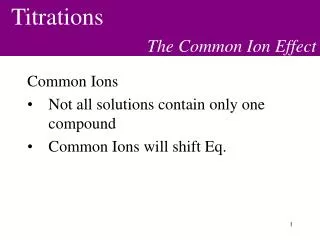
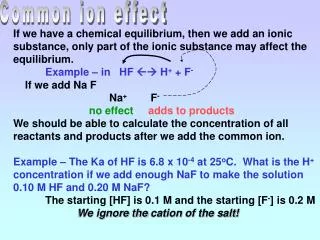
The common ion effect Will a precipitate form when two solutions are mixed?
Worked example 25 cm3 0f 0.0020 mol dm-3 potassium chromate ( KCrO4) are mixed with 75 cm3 of 0.000125 mol dm-3 lead (II) nitrate. Will a precipitate of lead chromate form? [ ksp lead(II) chromate = 1.8 x 10⁻¹⁴mol2 dm6]
Step 1 Determine the ionic equation PbCrO4 (s) = Pb2+ (aq) + CrO42- (aq) ksp = [ Pb2+ ] [ CrO4 2- ]
Step 2 Determine the initial concentrations of each ion when mixed [ CrO4 2- ] = 25/100 x 0.0020 mol dm-3 = 0.00050 mol dm-3
Step 3 Similarly work out the concentration of the Pb2+(aq) Answer = 0.000938 mol dm-3
Step 4 Multiply the two values from steps 2 and 3 Answer = 4.69 x 10⁻⁸ Ask : Is this greater than the numerical value for ksp ? Yes means a precipitate will form !