

Medicare
E N D
Presentation Transcript
Agenda • Parts & Choices in Medicare • Medicare Nuts & Bolts
Baby Boomers • Two years ago, 78 million “baby boomers” began retiring, in about 30 years, there will be twice as many older Americans as there are today. • The first wave of 3.2 million baby boomers turn 65 in 2011 — 365 an hour. • The number of workers paying into Social Security per beneficiary will drop from 3.3 today to about 2.1 in 2032. Source: -www.socialsecurity.gov - USA Today – “Social Security hits first wave of boomers”
Centenarians – People over 100 • 2010 has 70,490 centenarians! Largest in the world! • “I wouldn’t have retired so early if I knew I was going to live so long.” • -LeRoy Brown, Born: 1913 Retired: 1981 Today: Retired for 29 years and counting!
Senior Healthcare • Why… • Irony • The good news is that we are living longer! The bad news is that we are living longer. • Unplanned health care expenses are one of the largest risks to personal financial plans today.
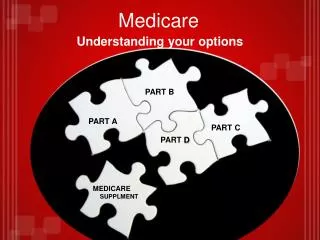
Medicare Basics 101 • Parts of Medicare • Part A: Hospital Insurance Covers inpatient hospital care, some skilled nursing facility care, home health care and hospice care. • Part B: Medical Insurance • Covers doctor services, outpatient services, durable medical equipment and some • home health care not covered by Part A. • Part C: Medicare Advantage Program • Formerly known as Medicare + Choice. • A health coverage option run by private companies approved by and under contract with Medicare. • Includes Part A, Part B, and usually other coverage like prescription drugs. • Part D: Prescription Drug Coverage • A prescription drug option run by private insurance companies approved by and under contract with Medicare • Helps cover the cost of prescription drugs. • May help lower your prescription drug costs and help protect against higher costs in the future. • Plus Medicare Supplements!
Your Medicare Choices • Original Medicare • Run by the Federal government. • Provides your Part A and Part B coverage . • You can buy a Medigap (Medicare Supplement Insurance) policy (sold by private insurance companies) to help fill the gaps in Part A and Part B coverage (like coinsurance, copayments, and deductibles). • You can join a Medicare Prescription Drug Plan to add drug coverage. • Medicare Advantage • Run by private insurance companies approved by and under contract with Medicare • Provide your Part A and Part B coverage, but can charge different amounts for certain services. May offer extra coverage and prescription drug coverage for an extra cost. Costs for items and services vary by plan. You still pay your Part B premiums to the Government, in addition to your MA premium. • If you want drug coverage, you must get it through your plan (in most cases). • Other Medicare Plans • Plans that aren’t Medicare Advantage Plans but are still part of Medicare. • Include Medicare Cost Plans, Demonstration/Pilot Programs, and Programs of All-Inclusive Care for the Elderly (PACE). • Most plans provide Part A and Part B coverage, and some also provide prescription drug coverage (Part D).
How to enroll in Medicare Part A and Part B when you have Social Security • Most people are enrolled automatically in Medicare Part A and Part B on the first day of the month they turn 65. • If you do not receive an enrollment notice from Social Security 3 months before your 65th birthday, call them at: • 800-772-1213 • If you are disabled, there is a 24 month waiting period for Medicare after you become disabled. During this time, you may qualify for Medicaid/Medical Assistance, COBRA coverage or services from state programs.
How to enroll in Medicare Part B when you have Social Security • Initial Enrollment Period: You can enroll in Part B during the three months before the month of your 65th birthday, the month you turn 65, or the three months after. If you are disabled, you can enroll after receiving disability benefits for 24 months. • If you don’t enroll in Part Be during your Initial Enrollment Period, a 10 % penalty typically will be added to your Part B premium for each year you delay enrolling in Part B (unless you qualify for a special enrollment period) • If you don’t enroll in Part B during your Initial Enrollment Period, you can enroll during the General Enrollment Period from January 1 through March 31 each year. Coverage begins on July 1 of the year you enroll. You will be charged a 10 percent penalty for each year you delay enrolling in Part B. This charge may increase as Medicare premiums increase and will continue for as long as you are enrolled in Part B.
Medicare – Special Enrollment Period • A Special Enrollment Period allows you to avoid the penalty for late enrollment. You may qualify for a Special Enrollment Period if: • You delayed Part B because you or your spouse has medical coverage through a union or employer with more than 20 employees, or • You cancelled Part B coverage because you went back to work and have group medical coverage. • The Special Enrollment Period lasts 8 months. It begins when your employer or union coverage ends or when your employment ends, whichever is first. Contact Social Security 4 months before you retire or when your employer or union coverage ends. Request a form that your employer will complete to begin your Special Enrollment Period. Then send the form with your Part B enrollment form to Social Security. • If you are age 65 and continue your employer coverage through COBRA, you should enroll in Medicare Part B. You will not get a special Enrollment Period when COBRA ends. You must sign up for Part B during the first 8 months of your COBRA coverage to avoid the late enrollment penalty.
How to enroll in Medicare Part B when you don’t have Social Security • What if you do not yet get Social Security benefits and you only want to apply for Medicare? • If you are close to age 65 and not getting Social Security benefits, you must apply for Medicare. You can apply by calling or visiting your local Social Security office, or by calling Social Security at 1-800-772-1213. You should apply three months before the month you turn 65. This is the beginning of your 7 month Initial Enrollment Period. If you wait until you are 65, or in the last 3 months of your Initial Enrollment Period, your Medicare Part B coverage start date will be delayed. You currently cannot apply for Medicare only online (using the Internet). • What if you do not want Medicare Part B during your Initial Enrollment Period? • If you do not want Medicare Part B during your Initial Enrollment Period, follow the instructions that come with the Medicare card three months before your 65th birthday.
Medicare Part A 2011(Hospital Coverage) • Part A • For each benefit period you pay: • -A total of $1,132 for a hospital stay of 1-60 days. • -$283 per day for days 61-90 of a hospital stay. • -$566 per day for days 91-150 of a hospital stay (Lifetime Reserve Days). • -All costs for each day beyond 150 days • Skilled Nursing Facility Coinsurance: If certain requirements are met • -Days 1 to 20: Medicare Pays 100% of Medicare approval amount • -Days 21 to 100: Medicare pays $141.50 per day • -Days over 100: Medicare pays nothing • Skilled care must be required • A prior 3-day hospital stay for the same condition is required (within 30 days) • The nursing home must be Medicare certified • The patient must be recovering
Medicare Part B 2011(Medical Insurance) • Part B • For each benefit period you pay: • -$162.00 annually • -Generally 20% of coinsurance • -All costs for excess charges • Other Miscellaneous Gaps • -Blood Deductible - All costs for first 3 pints • -Foreign Travel Emergency Care - All costs • -Preventative Care (physical or eye exams, hearing screening) - All costs • -Costs above usual and customary - All costs
Medicare Part C 2011(Medicare Advantage) • HMO • PPO • PFFS • MSA (Medical Savings Accounts) • SNP (Special Needs Plans)
Medicare Part D 2011(Prescription Drugs) • Medicare has contracted with private companies to offervoluntary prescription drug coverage. • There is a financial penalty for not enrolling of 1% per month for every month enrollment has been delayed. This penalty is paid for the remainder of their time on Medicare. • Medicare approved private drugs adhere to the defined minimum requirements for standard coverage. • Some plans may offer additional benefits for a higher premium. • If needs change, clients can switch options yearly with no questions asked (clients can choose from a new Part D plan during the annual election period, held October. 15 – December 7, 2011)
Medicare Basics 101 • Medicare Supplement Open Enrollment • & Guarantee Issue • Six month open enrollment period starts on the first day of the month in which someone is both: • Age 65 or older, and • Enrolled in Medicare Part B • Experiencing a change with existing Medicare coverage. • Ratio of guarantee issue vs. underwritten policies is changing dramatically for carriers.
Medicare Basics 101 • During the Medicare Supplement open enrollment period, an insurance company cannot: • Deny any individual coverage • Place conditions on a policy • Charge an individual more for a policy because of past or present health problems • If covered under an employer’s group health plan, an individual may want to delay taking Part B • Once the six-month Medicare Supplement open enrollment period starts, it cannot be changed • Credible coverage counts towards pre-existing waits
Medicare Supplement Facts • Before June 1, 2010: Standardized Plans • After June 1, 2010: Modernized Plans • 47 states have standardized Medicare Supplement plans referred to as Plan A through Plan L, with the exception of MA, MN and WI. Standardized plans mean the benefits are the same and regulated, no matter which company sells it. • Medicare Supplement plans are standardized and only private insurance companies offer them. When choosing a standardized Medicare Supplement plan, consumers look at the following: • Company rating and overall financial strength • Brand name recognition • Price • Efficiency in claims processing
Medigap Plans Effective on or after June 1, 2010 (Modernized Plans)
Minnesota: Standardized Medicare Supplement Plans • Pays 100% after you spend $1,000 in out-of-pocket costs for a calendar year. • Minnesota version of Medigap Plans K • and L are available, and Minnesota Plans M, N, and high deductible F will be offered effective June 1, 2010.
What’s happening to Medicare according to the Patient Protection & Affordable Care Act (PPPACA) – HR3590 Good News! • Part D coverage gap reduced. • Improves coverage of preventative benefits. • Annual physical exams provided. • Provides bonus payments to providers with high quality plans.
Website Sources • Federal Government –www.medicare.gov • Senior Resource Center for Medicare Information –www.medicare.org • Center for Medicare & Medicaid Services –www.cms.hhs.gov