LEADERSHIP
Key Terms. Management- Management is the process of setting objectives and making the most efficient use of financial, human and physical resources to achieve these objectives.Leadership-Leadership is influencing others to achieve certain aims or objectives . Key Terms. Quality circl


LEADERSHIP
E N D
Presentation Transcript
1. LEADERSHIP And management styles
2. Key Terms Management-
Management is the process of setting objectives and making the most efficient use of financial, human and physical resources to achieve these objectives.
Leadership-
Leadership is influencing others to achieve certain aims or objectives
3. Key Terms Quality circles-
These are teams of employees drawn from all levels of the organisation and given the task of solving operational problems. Single status-
Single status entails the removal of all barriers that distinguish between different grades of staff in the organisation.
Consultation-
this is when the managers ask for and take into account the views of subordinates
4. What do Leaders do? Leaders or managers have a broad rang of duties which may include:
Deciding objectives for the organisation.
Canvassing opinion.
Deciding Structure.
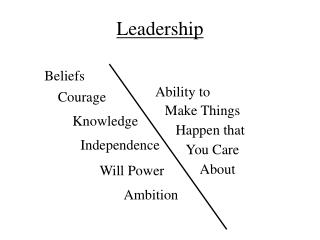
5. What Makes A Good Leader? Possessing an air of authority
Possessing self motivation and the desire to achieve great things
Being informed and knowledgeable about matters relating to the business
6. Styles Of Leadership
7. Authoritarian Style Description-
Senior managers take decisions with little involvement of junior employees.
Key Features-
Sets Objectives, allocates tasks and leader retains control throughout
Communication Used-
one way communication from leader to subordinate.
Circumstances-
when quick decisions are required or large numbers of unskilled employees are involved.
8. Authoritarian Or Autocratic Leadership Authoritarian leaders like to retain control over the business and do not give the employees much freedom of action.
They pass instructions to junior employees which leaves the subordinates few opportunities to discuss ideas and issues.
Autocratic leaders set objectives, allocate tasks and expect obedience from subordinates
ORGANISATIONS MANAGED IN AN AUTOCRATIC STYLE MAY FACE A NUMBER OF DIFFICULTIES:
Mistakes by subordinates can result in criticism and sometimes disciplinary action.
Senior managers tend to be overworked, and staff turnover is often high
9. Paternalistic Style Description-
Dictatorial, though decisions are made in the best interests of the employees.
Key Features-
Explains decisions and ensures that employees’ social and leisure needs are meet.
Communication Used-
Generally from leader downwards though some feedback takes place.
Circumstances
This is autocratic leadership with a human face, though it can appear democratic.
10. Paternalistic Leadership Paternalistic Leadership is autocratic in approach.
The paternal company treats its workforce as family.
Paternalistic leaders do gain the loyalty of their subordinates and the frequently have a low rate of staff turnover.
Paternalistic companies do not encourage their employees to be creative or to use their initiative.
11. Democratic Style Description
This is the running of a business on the basis of majority decisions
Key Features
This style of leadership encourages employees to take part in decision making and Uses delegation.
Communication Used
There is extensive two-way communication between junior and senior employees.
Circumstances
Useful when complex decisions are made requiring a range of specialist skills.
12. Democratic Or Participative Leadership Business decisions are made on the view of the majority.
The successful operation of this style requires,
This type of leadership may be more popular because, Democratic leadership encourages the following.
Leaders and subordinates discuss issues and employee participation is actively encouraged.
The leader acts upon advice, and explains the reasons for their decisions.
13. STYLE VERSATILITY Managers may believe that there is not a single perfect style of leadership.
It may be that the best managers are those who adopt to a single suitable style to the circumstances. Therefore it may be that the best managers are those that can adapt to more than one style of leadership
14. Douglas Mc Gregor’s Theory X And Y Douglas Mc Gregor was an American psychologist who researched into management in large companies.
Mc Gregor’s researched revealed that many leaders assumed their workers were motivated solely by money.
Theory Y leaders believed that employees wanted more than financial gain from working.
Mc Gregor didn’t believe in the views expressed by theory X leaders.
Mc Gregor work set out the leadership style likely to introduce the methods of motivation proposed by Maslow and Herzberg.
15. Theory X And Y Although Mc Gregor wholeheartedly supported the theory Y view of leadership, this doesn’t mean that theory X has no place.
A theory X view of leadership would be appropriate under the same circumstances as an autocratic style.
A theory X manager is likely to adopt an autocratic style, whilst a theory Y leader would be expected to use a more democratic approach.
16. Theory Beliefs.
17. Management By Objectives According to Drucker’s theory to management by objectives, managers should:
Identify and agree targets for achievement with subordinates
Evaluate overtime the extent to which these objectives are met.
The objectives set for each individual should be co-ordinated to ensure that the business achieves its corporate objectives. Each member of staff, therefore, makes a contribution towards the business objectives.
18. The Advantages Of MBO It can improve communication within the organisation as the target setting and evaluation takes place
MBO can highlight training needs for managers and subordinates, improving their performance and productivity.
19. The Disadvantages Of MBO All employees within the organisation must be committed to the technique if it is to succeed and benefit the business.
Setting targets for highly specialised employees can be difficult and tends to remove the focus from the mainstream corporate objectives.
20. Team-Based Leadership Team working occurs when production is organised into substantial units of work.
Team work is common within organisations and often accompanies delayering major multinational organisations such as volvo.
21. Potential Problems With Teams Teams may aim for goals that are not the corporate objectives.
Teams can become complacent, confident in their own success and unaware of major changes taking place outside the team.
22. Single Status Under single status all employees within an organisation.
Work similar hours.
Wear the same company – often a company overall.
Are entitled to similar holiday arrangements.
23. Delegation And Consultation Delegation means managers give junior employees the authority to carry out particular tasks.
A consultative manager would seek employees views on important issues
24. Delegation And Consultation