Download
1 / 5
50 likes | 169 Views
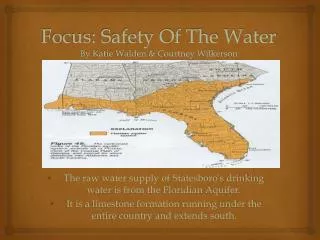
Focus: Safety Of The Water By Katie Walden & Courtney Wilkerson. The raw water supply of Statesboro's drinking water is from the Floridian Aquifer. It is a limestone formation running under the entire country and extends south. Safety of the Floridian Aquifer.

E N D
Focus: Safety Of The WaterBy Katie Walden & Courtney Wilkerson The raw water supply of Statesboro's drinking water is from the Floridian Aquifer. It is a limestone formation running under the entire country and extends south.
Safety of the Floridian Aquifer • Raw water from this Aquifer has very high quality. • It is withdrawn from the Aquifer through five active deep wells. • Water Treatment Includes: chlorination (which is a disinfection), fluoridation (prevents tooth decay in children’s teeth), and phosphate (for iron control).
Contaminates In Water Source • As water travels through the surface of the ground in lakes, rivers, streams, and springs, it may pick up: • minerals, • various bacteria, • and substances provided by human or animal activity. • The presence of this contaminates does no necessary post a threat for people that are drinking the water.
Bottled Water Is Better Than Tap Water? • MYTH! • Due to aggressive advertising, bottled water companies has convinced communities that bottled water is clean and safer than tap water. • After a four year study, they have proven that is not the case. In fact, 25 percent of bottled water is actually just bottled tap water. • This makes people spend 10,000 times more per gallon, when they are basically the same water.
Want To Save Money & Water? • Fill your dishwater to maximum capacity, they use 15 gallons PER cycle. • Turn off the tap while brushing your teeth. • Check every faucet for leaks, just a slow drip can waste 15-20 gallons A DAY! • Check for leaks in your toilet, it is not uncommon to lose 100 gallons of water a day from an invisible toilet leak.