Introduction to C Programming: Course Details and Resources
This course covers the fundamentals of programming in C, guided by instructor Lei Wang. Students will learn through ten lectures, focus on labs, and engage with pop quizzes. The prerequisites include CSE321 or an equivalent background. The core textbook is "The C Programming Language" by Kernighan & Ritchie. Course communication will occur on the cse.course.cse45921 newsgroup. Emphasis will be placed on coding style, Makefiles, and practical programming skills. Office hours are Friday 4:00-5:00 PM for personalized guidance.

Introduction to C Programming: Course Details and Resources
E N D
Presentation Transcript
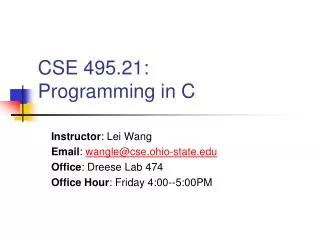
CSE 495.21: Programming in C Instructor: Lei Wang Email: wangle@cse.ohio-state.edu Office: Dreese Lab 474 Office Hour: Friday 4:00--5:00PM
Course Information: • Course Page: • http://www.cse.ohio-state.edu/~wangle/courses/459.21sp12/index.html • Prerequisite: • cse321 or equivalent • Textbook: • The C Programming Language, Kernighan & Ritchie • Newsgroup: • cse.course.cse45921, • the main forum of class communication • Office hour stop-by or appointments
Syllabus: • Lectures: • Ten lectures covering Ch. 1-8, • Ch. 2-3, read on your own • Occasional pop quizzes • Labs: • Four labs, 20% each • Electronic submission • run on stdlinux.cse.ohio-state.edu • lab quality, correctness • Additional emphasis on Coding style and Makefile • Exams: • None, but all others count
A little history: • 1970’s • Unix • C, from BCPL (Thompson and Ritchie) • C programming Language • Widely used like the others: Fortran, Pascal • Main form of language for system programming • Available on any machine with C compiler and library
Some Characteristics: • Scope: • Intended: • HPC, OS, general programming • Typically, long developing cycle • very platform dependent • Not intended: web, scripting, data processing • Features: • Close interaction with system • Standard library (user-level only), • no other fancy stuff: networking, memory, graphics • Extensive use of pointers • Procedure programming, strictly pass by value
Sample 1: /* Hello World! */ #include <stdio.h> int main() { printf(“Hello World!\n”); return 0; }
Walk through: • C program: hello.c • emacs, vi, vim, pico, joe … • But text editors only. No word processor • Preprocessing: hello.s, assembly code • cc -S hello.c • Compilation: hello.o, a binary file • cc -c hello.s • Linking: a.out or hello, an executable file • cc hello.o • cc -o hello hello.o • Loading (dynamical linking) and execution: ./hello • ./a.out • ./hello
Programming (Editing) • C program: hello.c • emacs, vi, vim, pico, joe … • But text editors only. No word processor
Compile: • Preprocessing: hello.s, assembly code • cc -S hello.c • Can you take a look at hello.s and compare to hello.c? • Compilation: hello.o, a binary file • cc -c hello.s • Do you know how to take a look at hello.o? • Linking: a.out or hello, an executable file • cc hello.o • cc -o hello hello.o • Want to look at the executable, hello?
Run: • Loading (dynamical linking) and execute: ./hello • ./a.out • ./hello • What you do with java programs? • What computer does to run your program?
Sample 1 Dissection: • What it has? • A function definition: main • A line of comment • A line of preprocessor directive • An output statement • A return clause • What it does? • Ask the computer to say hello to the world. • What it does not do? • It seems not computing!! • No real work • not taking input • does not change any value
Sample 2: • #include <stdio.h> • #define MAGIC 10 • int main(void) • { • int i, fact, quotient; • while (i++ < 3) { • printf(”Guess a factor of MAGIC larger than 1: "); • scanf("%d”, &fact); • quotient = MAGIC % fact; • if (0 == quotient) • printf(”You got it!\n”); • else • printf(”Sorry, You missed it!\n”); • } • return 0; • }
Sample 2 Dissection: • What more it has? • Macro definition • Variable declaration • Operations represented by operators • Conditional computation • Input Processing • Loops: three chances
Syntax Dissection: • What is syntax? • m-w.com: • the way in which linguistic elements (as words) are put together to form constituents (as phrases or clauses) • How to put your C elements together into a program? • Variable declaration, • Identifier: case, keywords, style • datatype specification • char, short, int, long, float, double • Operators: • +, -, *, /, %, ++, --; >, <, ==, ; &, |, … • Priority and Precedence • Associativity
More Syntax Dissection: • Preprocessor directive • macro • header file inclusion • Loop constructs • for, while, do-while, break, continue, label--go; • Conditional statements • If, else, else if, switch, break • Function definition • return type, parameter definition, parameter passing • Standard library and function calls • Take home practice: • Walk through the following steps with sample 2 • preprocessing, compilation, linking, loading/execute • Modify and repeat once more if you can