Utility and Practical Application
This resource discusses the utility of comics as a dynamic educational tool, particularly for students who struggle with traditional texts or are non-majors. By incorporating comics into the learning experience, educators can create a vibrant classroom atmosphere that actively engages students, fosters critical thinking, and develops literacy skills. The use of comics can help to overcome barriers to learning, making the educational process more inclusive and effective. This innovative approach is supported by research on comics' potential to enhance understanding and motivation.

Utility and Practical Application
E N D
Presentation Transcript
Utility and Practical Application Comics • A means of communicating with students challenged by traditional texts* and non-majors** • A way to shake up the learning experience and add vibrancy to the classroom *Gretchen Schwarz, “Expanding Literacies through Graphic Novels,” The English Journal 95.6 (2006): 58-64. **Hosler, J, and K. B. Boomer. “Are Comic Books an Effective Way to Engage Nonmajors in Learning and Appreciating Science?” CBE Life Sciences Education 10.3 (2011): 309–317.
Utility and Practical Application Comics • A means of communicating with students challenged by traditional texts* and non-majors** • A way to shake up the learning experience and add vibrancy to the classroom • Engages the student in an era of distraction*** *Gretchen Schwarz, “Expanding Literacies through Graphic Novels,” The English Journal 95.6 (2006): 58-64. **Hosler, J, and K. B. Boomer. “Are Comic Books an Effective Way to Engage Nonmajors in Learning and Appreciating Science?” CBE Life Sciences Education 10.3 (2011): 309–317. ***Jeremy Short and Terrie Reeves. “The Graphic Novel: A ‘Cool’ Format for Communicating to Generation Y,” Business Communications Quarterly 72.4 (2009): 414-430.
Utility and Practical Application Comics • Comics as outsider texts* *Duffy, Damian. “Out of the Margins ... into the Panels: Toward a Theory of Comics as a Medium of Critical Pedagogy in Library Instruction.” Critical Library Instruction: Theories and Methods. Ed. Maria T. Accardi, Emily Drabinski, & Alana Kumbier. Duluth, MN: Library Juice Press, 2010. 199–219.
Utility and Practical Application Comics • Comics as outsider texts* • Participatory** *Duffy, Damian. “Out of the Margins ... into the Panels: Toward a Theory of Comics as a Medium of Critical Pedagogy in Library Instruction.” Critical Library Instruction: Theories and Methods. Ed. Maria T. Accardi, Emily Drabinski, & Alana Kumbier. Duluth, MN: Library Juice Press, 2010. 199–219. **S. W. Smith. “Academaesthetics: How the Essay and Comic can Save Each Other.” Text, 11.2 (2007): 1–55.
Utility and Practical Application Comics • Comics as outsider texts* • Participatory** • Promotion/Advocacy (Join LizzZitron and me for a discussion of Innovative Outreach: 4 -5 TODAY in Palm Garden Ballroom D *Duffy, Damian. “Out of the Margins ... into the Panels: Toward a Theory of Comics as a Medium of Critical Pedagogy in Library Instruction.” Critical Library Instruction: Theories and Methods. Ed. Maria T. Accardi, Emily Drabinski, & Alana Kumbier. Duluth, MN: Library Juice Press, 2010. 199–219. **S. W. Smith. “Academaesthetics: How the Essay and Comic can Save Each Other.” Text, 11.2 (2007): 1–55.
Utility and Practical Application Narrative • Modeling behavior • Situational • Motivation • Multiple Voices and Viewpoints • Fictionalizing to provide context* • Retention and recall** • Coming to terms with our own illiteracy*** *Tabachnick, Stephen E. “A Comic - Book World.” World Literature Today 81.2 (2007): 24–28. **Negrete, Aquiles, and Cecilia Lartigue. “Learning from Education to Communicate Science as a Good Story.” Endeavour 28.3 (2004): 120–124. ***Smith, S. W. “Academaesthetics: How the Essay and Comic can Save Each Other.” Text, 11.2 (2007): 1–55.
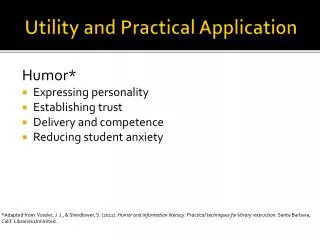
Utility and Practical Application Humor* • Expressing personality *Adapted from Vossler, J. J., & Sheidlower, S. (2011). Humor and information literacy: Practical techniques for library instruction. Santa Barbara, Calif: Libraries Unlimited.
Utility and Practical Application Humor* • Expressing personality • Establishing trust *Adapted from Vossler, J. J., & Sheidlower, S. (2011). Humor and information literacy: Practical techniques for library instruction. Santa Barbara, Calif: Libraries Unlimited.
Utility and Practical Application Humor* • Expressing personality • Establishing trust • Delivery and competence *Adapted from Vossler, J. J., & Sheidlower, S. (2011). Humor and information literacy: Practical techniques for library instruction. Santa Barbara, Calif: Libraries Unlimited.