Understanding Acceleration: Measuring Changes in Velocity
70 likes | 193 Views
Acceleration is the rate at which an object's velocity changes, influenced by the net force applied and the object's mass. When speed, direction, or both change, an object experiences acceleration. The greater the force, the more the acceleration, while an increase in mass results in less acceleration. Average acceleration can be calculated using the formula ( a = Delta V / t ), where ( Delta V ) is the change in velocity. Units for acceleration can be complex, often represented as distance/time², highlighting the relationship between speed, velocity, and acceleration.


Understanding Acceleration: Measuring Changes in Velocity
E N D
Presentation Transcript
February 2014 ACCELERATION
How do we measure changes in velocity? • Acceleration • The rate at which velocity changes • An object accelerates if its speed, direction or both change
The acceleration of an object is directly proportional to the net force applied to it • The BIGGER the force, the MORE the acceleration • The acceleration of an object is inversely proportional to the mass of the object • The BIGGER the mass, the LESS the acceleration
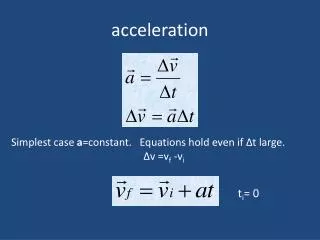
Calculating average acceleration • Acceleration = ∆V/ t Vf = final velocity Vi = initial velocity
Units for acceleration: • Speed and velocity are easily measured in distance/time units (such as km/hr, m/s) • Units for acceleration are more complicated: • Sample problem: What is the acceleration if we speed up from 10km/h to 30 km/h in 10 seconds? • Acceleration= ∆V = 30 km/h – 10 km/h = 2 km/h/s t 10 sec • Distance/time/time
Summary • How fast = SPEED • How fast and in what direction = VELOCITY • How quickly velocity changes = ACCELERATION • The term “acceleration” - velocity increases • The term “deceleration” - velocity decreases (or negative acceleration)