Download

1 / 29
290 likes | 409 Views
This overview provides essential insights into the nature and life cycle of viruses. Viruses, composed of nucleic acids and proteins, lack cellular structures and metabolic pathways, relying entirely on living cells for replication. By hijacking host cell machinery, they reproduce and assemble new virus particles. It details how viruses attach to host cells, enter them, replicate, and release new viral particles, emphasizing their specificity for certain host types. Understanding these mechanisms is crucial for developing treatments and preventive measures against viral infections.

E N D
The Viruses January 14th, 2010
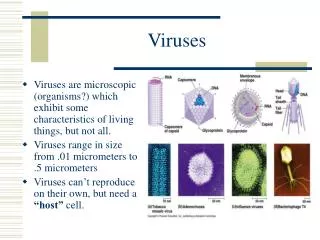
Virus Basics • Viruses are nucleic acid and protein structures • Very small; typically between 20-200 nm • No cellular structures • No ribosomes • No metabolic pathways (Glycolosis, Kreb’s cycle, electron transport chain, etc.) • Few or no enzymes
Virus Basics • Viruses carry out NO growth or metabolism on their own • They are dependent on living cells for their replication • Can exist in the environment, but do not replicate • To replicate, they must come in contact with a host organism
Virus Basics • Viruses replicate by infecting a host cell and hijacking the host cell’s replication machinery to produce more viruses • Host cell DNA replication • Host cell RNA transcription • Host cell RNA translation • Host cell protein and membrane building capacity
Virus Basics • They are generally host-specific • Infect only certain cell types • Influenza and lung tissue • Norovirus and intestines • Hepatitis B and liver cells
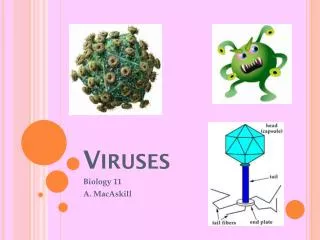
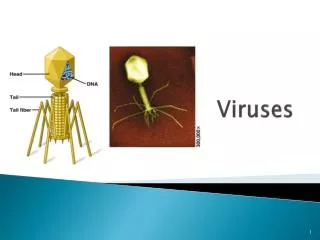
Virus structure • Viruses are mostly nucleic acid and protein • Protein shell • May be surrounded by a lipid envelope • Nucleic acid inside
The viral capsid • Made of protein subunits • Repeating patterns • Symmetrical structure • Can have proteins, lipids, and sugars on the surface • These outer structures interact with host cells
Virus envelopes • Viruses can be enveloped or non-enveloped • Enveloped • Lipid bilayer surrounds the capsid • Similar to a cell membrane • Non-enveloped • Protein shell only
Internal structures • Capsid forms a shell around the nucleic acid • Some viruses carry their own enzymes inside the capsid
http://biology.kenyon.edu/slonc/gene-web/Lentiviral/Lentivi2.htmlhttp://biology.kenyon.edu/slonc/gene-web/Lentiviral/Lentivi2.html
Nucleic Acids • Typically a single nucleic acid • Can be DNA or RNA • Single or double stranded • Size: 32-kbp • Encode proteins the virus needs to take over a cell and reproduce itself • Replication proteins • Structural proteins
Example: the poliovirus genome http://www.jci.org/articles/view/22139/figure/1
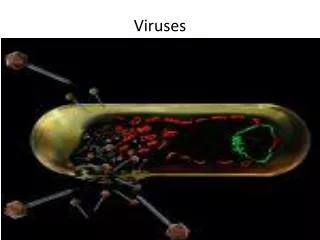
Virus attachment • Viruses attach to cells via a receptor • Molecule on the surface of a cell that the virus can recognize and attach to • Like a lock and key • These cell receptors often serve a useful function for the host cell; viruses have simply evolved to exploit them
Virus entry • Once attached, virus goes through the cell membrane into the cytoplasm • Entry happens through different mechanisms • Penetration • Membrane fusion
Production of new viruses • Take over the cell’s replication machinery • Stop the cell’s own nucleic acid replication, transcription, and translation processes • All the cell’s energy goes into creating more viruses
Viral replication: DNA viruses • Virus DNA serves as the template • Host cell enzymes replicate more pieces of viral DNA • Host cell enzymes transcribe viral DNA into mRNA • Host cell ribosomes translate viral mRNA into proteins
Viral replication: RNA viruses • Viral RNA serves as the template • Translated directly into proteins by the host cell ribosomes • However, the viral RNA still needs to be replicated for making more viruses • Human and animal cells do not have enzymes for replicating RNA • These enzymes are encoded on the viral genome • The host cell ribosomes produce these enzymes, allowing the virus to replicate its own nucleic acid
Virus assembly • Nucleic acids associate with capsid proteins • Proteins assemble into capsid structures • Complete virus particles assemble in the cytoplasm of the cell
Release from the cell • Viruses can pass through the cell membrane • May rupture the cell and escape • Enveloped viruses: may “bud” out, taking part of the cell membrane to form their envelope • Infect adjacent cells • Release into the environment • Release into host cell body fluids that can spread infection
Viruses in the environment • Can remain viable in a variety of environments • Water • Air • Soil • Food • Can remain infectious for long periods until they encounter a host cell