Context-Specific Vocal Sequences in Campbell's Monkeys: Insights into Proto-Syntax
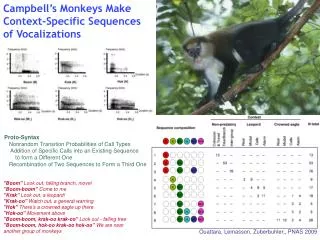
This study explores the unique vocalization patterns of Campbell's monkeys, revealing their ability to form context-specific sequences indicative of proto-syntax. It highlights nonrandom transition probabilities between call types and how new calls can be inserted to create different sequences. These vocalizations serve crucial roles in communication, including warnings about predators like leopards or dangers from falling branches. By examining combinations of calls, researchers demonstrate the advanced cognitive abilities of these primates. Findings are illustrated through specific call examples, showcasing complex communication strategies.

Context-Specific Vocal Sequences in Campbell's Monkeys: Insights into Proto-Syntax
E N D
Presentation Transcript
Campbell’s Monkeys Make Context-Specific Sequences of Vocalizations Proto-Syntax Nonrandom Transition Probabilities of Call Types Addition of Specific Calls into an Existing Sequence to form a Different One Recombination of Two Sequences to Form a Third One "Boom" Look out, falling branch, move! "Boom-boom" Come to me "Krak" Look out, a leopard! "Krak-oo" Watch out, a general warning "Hok" There's a crowned eagle up there "Hok-oo" Movement above "Boom-boom, krak-oo krak-oo" Look out - falling tree "Boom-boom, hok-oo krak-oo hok-oo" We are near another group of monkeys Leaning Wa Ouattara, Lemasson, Zuberbuhler,, PNAS 2009