Understanding Claudin Mutants and Chimeras: A Study on Structural Variations
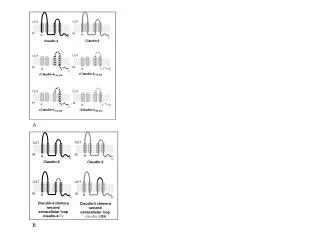
This study explores the structural variations and functionalities of claudin proteins, specifically focusing on claudin-2 and claudin-4, along with their chimeras and mutants. Key diagrams illustrate the predicted structures of recombinant claudin species and highlight point mutations affecting the second extracellular loop. Notable constructs, such as Claudin-2 chimeras and the impact of mutations like Claudin-4 N149D/S and Claudin-2 S149N, were assessed through various experiments to elucidate their roles in cellular processes. The findings contribute to a deeper understanding of tight junction biology.

Understanding Claudin Mutants and Chimeras: A Study on Structural Variations
E N D
Presentation Transcript
OUT OUT OUT OUT IN IN N N C C rClaudin-2136-230 rClaudin-4136-209 IN IN N N C C Claudin-4 Claudin-2 OUT OUT OUT OUT IN IN N N C C rClaudin-2108-230 rClaudin-4108-209 IN IN N N C C Claudin-4 chimera second extracellular loop claudin-4/E2 Claudin-2 chimera second extracellular loop claudin-2/E4 OUT OUT IN IN N N C C Claudin-2 Claudin-4 A B
C Claudin-1D150N N S N D S N D N C Supplemental Fig. 1. Diagrams of claudins, chimeric claudins, claudin C-terminal fragments, and claudin mutants used in this study. (A) Predicted structure of the claudin components of recombinant claudin species used in Fig. 2 experiments. (B) Predicted structure of claudin chimera constructs used in Fig. 2 and 3, noting the change in the ECL-2 of Claudin-2/E4 and Claudin-4/E2. (C) Representation of claudin ECL-2 point mutations, with amino acid change indicated, that were used as soluble rClaudins in Fig. 5 experiments or were stably expressed by Rat1-R12 fibroblast transfectants in Fig. 6 studies. OUT OUT IN N N C Claudin-4N149D C C Claudin-4N149S OUT OUT IN N N Claudin-2S149N