Download
1 / 9
90 likes | 221 Views
This resource delves into the concept of series and their representation using sigma notation. It explains how a series can be expressed in an abbreviated form, showcasing examples like the summation of an arithmetic sequence (2 + 4 + 6 + ... + 100). The document covers essential terms such as 'summand' for the term pattern and 'index' for the position in the series. Additionally, it provides formulas for computing the sum of the first n terms in both arithmetic and geometric series, accompanied by multiple examples for clarity.

E N D
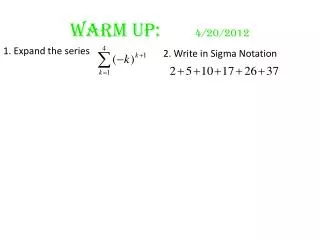
Warm Up: 4/20/2012 1. Expand the series 2. Write in Sigma Notation
Types of Sequences • Summation Sign: , A series can be written in an abbreviated form using the Greek letter sigma. • Example: 2+4+6+8+…+100 • Summand: Is the term 2n or the pattern. • Index: n is the index.
Sums • The sum of the first n terms of an arithmetic series is… • The sum of the first n terms of a geometric series with common ratio r is…
EXAMPLE #1 Find the sum of the first 40 terms
Example #2 Evaluate
Example #3 Evaluate
Example #4 Find the sum of the first 10 terms
Example #5 Evaluate