Download
1 / 15
150 likes | 277 Views
The Metric System, or International System of Units (SI), provides a standardized way to measure various quantities such as length, mass, volume, temperature, and area. This guide covers the essential SI units: meters (m) for length, grams (g) for mass, liters (L) for volume, and the various methods to measure and convert these units. Learn how to effectively use metric units for data measurement and discover tools such as triple beam balances, graduated cylinders, and the importance of accurate measurement in scientific contexts.

E N D
Metric System Measuring DataLearning Objectives 1. Identify correct SI units of measurement for length, mass, volume, temperature and area 2. Use metric units to measure various data
Metric system • Scientists use a common measurement system so they can compare their results. • Single standard system of measurement is called the metric system or International System of Units (SI for short) • Only countries that do not use metric system: • United States • Burma (Myanmar) • Liberia • Based on factors of 10
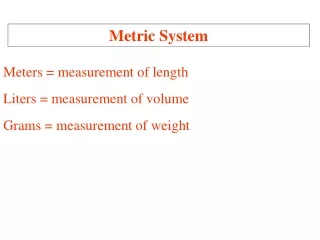
Base Units • Mass - the amount of matter that makes up an object • Unit of Measurement: grams (g) • Volume- the amount space occupied by a solid, liquid, or gas • Unit of Measurement: liter (L) • Length - the measurement of something from end to end • Unit of Measurement: meter (m)
Mass 1 ton dump truck = 1000 kg = 2000 lbs • grams (g) 1 marble = 3 g Volume 1 can of soda = 355 mL • liters (L) Shoe size of 9 (women) = 9.85 in = 25.1 cm Length Shoe size of 9 (men) = 10.25 in = 26 cm • meters (m)
Base unit: meters, grams, or Liters Kate Hudson doesn’t understand doing college math.
Mass • Mass - the amount of matter that makes up an object • Unit of Measurement: gram • Tools: triple beam balance or scale • Mass is not the same as weight. • Weight- the gravitational pull of an object • Ex. Gravitational pull on the moon is less, so we weigh less on the moon (6 times less) • Person who weighs 100 lbs on Earth = 16 lbs on Moon
Volume • Volume- the amount of space occupied by a solid, liquid, or gas • Unit of Measurement: liter (L) • Volume of liquid is measured using a graduate cylinder or a beaker that is marked with a scale in milliliters (mL)
Volume For irregular shaped objects like a rock, the water displacement method is used. Beaker or graduated cylinder is filled with water to specific level, object is placed in beaker. Change in water level = volume of object. • For objects with regular shape like a cube or rectangular prism, we can use a formula to calculate its volume. • Volume of a cube = side x side x side • Volume of rect. Prism = length x width x height
Reading a Graduated Cylinder 11.5 mL meniscus What is the volume of the liquid in the graduated cylinder?
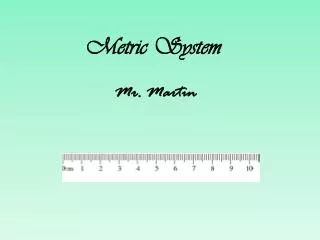
Length radius width length diameter • Length- the measurement of something from end to end • Under SI system, the base unit for length is meter (m) • Tools: ruler or meter stick, or measuring tape
Area • Area- the inside shape or space of a an object measured in square units • In rectangles and in squares, a simple calculation of length times width will give the number of square units 2 x 2 = 4 m² 4 x 4 = 16 m²
Temperature Temperature– a measure of how warm or cold an object is with respect to some standard ● Fahrenheit (US) after G.D. Fahrenheit 32°F = freezing 212°F = boiling ● Celsius (rest of world) after A. Celsius 0°C = freezing 100°C = boiling
How do you convert? To Convert to CelsiusTo Convert to Fahrenheit Tº C = Tº F – 32 Tº F = 1.8 (Tº C) + 32 1.8