Download
1 / 11
110 likes | 224 Views
This section delves into the principles of reaction rates as governed by collision theory. Key factors affecting reaction rates include the frequency and successful orientation of collisions among reactant particles, the activation energy required for a reaction to proceed, and external influences such as surface area, concentration, temperature, and catalysts. A higher surface area increases collision opportunities, while higher concentration and temperature enhance reaction likelihood. Additionally, catalysts and enzymes play vital roles in accelerating reactions without being consumed in the process.

E N D
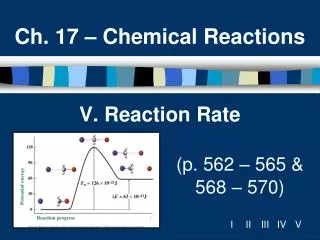
Ch. 17 – Chemical Reactions V. Reaction Rate(p. 562 – 565 & 568 – 570)
A. Collision Theory • Reaction rate depends on the collisions between reacting particles. • Successful collisions occur if the particles... • collide with each other • have the correct orientation • have enough kinetic energy to break bonds
A. Collision Theory • Particle Orientation Required Orientation Unsuccessful Collisions Successful Collision
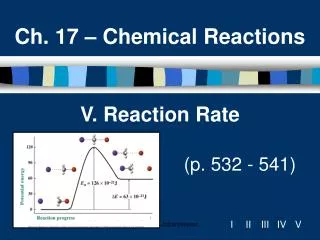
A. Collision Theory Activation Energy • Activation Energy (Ea) • minimum energy required for a reaction to occur
A. Collision Theory Ea • Activation Energy • depends on reactants • low Ea = fast rxn rate
B. Factors Affecting Rxn Rate • Surface Area • high SA = fast rxn rate • more opportunities for collisions • Increase surface area by… • using smaller particles • dissolving in water
B. Factors Affecting Rxn Rate • Concentration • high conc = fast rxn rate • more opportunities for collisions
B. Factors Affecting Rxn Rate • Temperature • high temp = fast rxn rate • high KE • fast-moving particles • more likely to reach activation energy
B. Factors Affecting Rxn Rate • Temperature Analogy: 2-car collision 5 mph “fender bender” 50 mph “high-speed crash”
B. Factors Affecting Rxn Rate • Catalyst • substance that increases rxn rate without being consumed in the rxn • lowers the activation energy
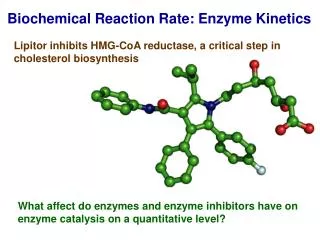
B. Factors Affecting Rxn Rate • Enzyme Catalysis