Long-Term Behavioral Changes in Deep-Sea Communities: Insights from Aloha Cabled Observatory
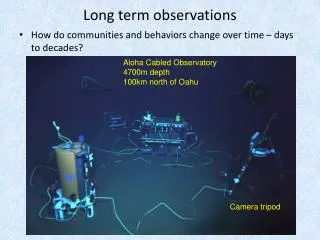
The Aloha Cabled Observatory, located 4700 meters deep and 100 km north of Oahu, conducts long-term observations on how communities and behaviors change over time, ranging from days to decades. With a camera tripod capturing 450 observations of marine animals monthly, shrimp and other invertebrates account for 93% of these observations. Current research is investigating temporal patterns in abundance, focusing on species such as Enypniastes, cucumber, rattail fish, Aristeid shrimp, polychaete worms, and benthic shrimp.

Long-Term Behavioral Changes in Deep-Sea Communities: Insights from Aloha Cabled Observatory
E N D
Presentation Transcript
Long term observations • How do communities and behaviors change over time – days to decades? Aloha Cabled Observatory 4700m depth 100km north of Oahu Camera tripod
450 observations of animals per monthshrimp and other inverts make up 93% of observationstemporal patterns in abundance under investigation Enypniastes cucumber Rattail fish AristeidShrimp Polychaete worms Benthic shrimp