Download
1 / 18
180 likes | 315 Views
At the IoP HEPP Conference in Dublin, the DRIFT collaboration presented their cutting-edge research on dark matter detection. Focusing on Weakly Interacting Massive Particles (WIMPs), the DRIFT experiment aims to identify galactic dark matter signals using directional information from nuclear recoil tracks. The presentation covered the latest advancements in the Negative Ion Time Projection Chamber (NITPC) and the project’s development from DRIFT-I through DRIFT-II, detailing the detector's physics, the collaboration's extensive international network, and ongoing data analysis efforts.

E N D
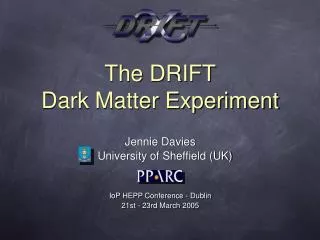
The DRIFTDark Matter Experiment • Jennie Davies • University of Sheffield (UK) • IoP HEPP Conference - Dublin • 21st - 23rd March 2005
Outline • Why? • Dark matter • Who? What? • Where? When? • How? • The detector • Recent developments
DRIFT... Why? • To search for dark matter and identify a signal of galactic origin using directional information from nuclear recoil tracks.
DRIFT... Why?Dark Matter: The Evidence • Observational evidence • Rotational curves of galaxies • Gravitational lensing • Theoretical support • Supersymmetry
DRIFT... Why?Dark Matter: The Candidates • Baryonic particle candidates • Non-baryonic particle candidates • Neutrinos • Weakly Interacting Massive Particles (WIMPs) - The stable LSP (neutralino) • Axions • Dark Energy
DRIFT... Why?Dark Matter: WIMPs • Cold Dark Matter • Neutral • High mass (10 -1000 GeV) • Interact only very weakly • Postulated ‘WIMP Wind’ • Daily fluctuations due to the Earth’s rotation
DRIFT... Who?The DRIFT Collaboration • UK Dark Matter Collaboration • University of Sheffield • University of Edinburgh • Imperial College, London • Rutherford Appleton Laboratory • Occidental College, Los Angeles, USA • Temple University, Philadelphia, USA • University of New Mexico, USA • University of Boston, USA • University of Thessaloniki, Greece • University of Darmstadt, Germany
DRIFT... What? • Directional • Recoil • Identification • From • Tracks
DRIFT... What? • Negative Ion Time • Projection Chamber (NITPC) • Two back-to-back field cages • with a shared central cathode • Two readout planes - Multi-Wire Proportional Chambers (MWPCs) • Filled with CS2 gas at low pressure Martoff et al. NIM-A 440 (2000) 355
DRIFT... Where? Boulby mine Cleveland Potash Ltd.
DRIFT... When? • DRIFT-I • Underground in 2001 • Data taking 2001-2004 • Shielding installed 2004 • Decommissioned 2004
DRIFT... When? • DRIFT-II • Underfloor shielding Autumn 2004 • 1st vessel u/g December 2004 • 1st detector u/g February 2005 • Further modules to go u/g throughout 2005 and on
DRIFT... How? • Nuclear recoils (elastic scattering) • Low energy ionisation • 0.01 - 1 kg-1 day-1 • Directionally sensitive • IMPORTANT: • Background reduction • gammas, alphas, neutrons etc. • require << 1 recoil per year
Simulations • Using SOURCES, GEANT4 and FLUKA • Neutron energy spectra (U & Th contamination) • Muon-induced neutrons • Geometry and particle tracking Carson et al. Astrop. Phys. 21 (2004) 667 Carson et al. hep-ex/0503017 (accepted to NIM-A)
Simulations • Single and grouped DRIFT modules • Hydrocarbon neutron shielding • Reduce recoils due to neutron background to < 1 per year per module
Alner et al. NIM-A 535 (2004) 644 Data Analysis • DRIFT-I Snowden-Ifft et al. NIM-A 498 (2003) 155
55Fe gamma Cosmic neutron Alpha Data Analysis • Commissioning of the first DRIFT-II detector has been performed at Occidental College, L.A. • Initial calibration and background runs successful • Data analysis software is progressing as early data is being taken • Waveform plotting and data reduction • Parameter calculation and plotting • Software cuts in progress
Looking ahead ... • DRIFT-II • In progress • DRIFT-III • towards 1000 kg • target mass • Plus • Further improved simulations • Charge readout R & D • Much data taking and analysis