Creating a Republic: The Birth of American Government and the Constitution
360 likes | 524 Views
Chapter 7 of U.S. History explores the formation of the American Republic, detailing the transition from the Articles of Confederation to the U.S. Constitution. It examines key figures such as George Washington, Alexander Hamilton, and Benjamin Franklin, as well as critical events like Shay's Rebellion, which highlighted the weaknesses in the Articles. The chapter discusses the Constitutional Convention, the Great Compromise, and the importance of the Bill of Rights, outlining the principles of a government designed to protect citizens' rights and limit governmental powers.


Creating a Republic: The Birth of American Government and the Constitution
E N D
Presentation Transcript
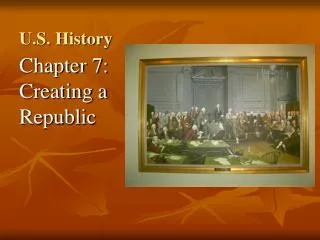
U.S. History Chapter 7: Creating a Republic
Uniting the Colonies States wrote Constitutions: to set limits of government powers and to spell out the rights of citizens.
Constitution • Document that sets out laws, principles, organization, and processes of government
EXECUTE • Carry out; do what is required • New state governments had legislatures to pass laws; governors would execute the laws.
ARTICLES OF CONFEDERATION • Articles were weak because no court system existed to settle disputes between states. • Also, there was no executive to carry out the laws.
ARTICLES OF CONFEDERATION • After Shay’s Rebellion, George Washington and others thought the Articles should be revised. • They believed the government failed to solve the nation’s economic problems
Depression • A period when business activity slows, prices and wages fall, and unemployment rises.
Noah Webster • He believed the nation needs a strong central government to be effective. • No real power rests with the federal government in a “pretend union.”
Noah Webster • He believed that individual states have too much power to form a true union. • Alexander Hamilton agreed.
Constitutional Convention • Goal to revise the Articles of Confederation.
Constitutional Convention • George Washington and Alexander Hamilton were two of the leading delegates • Benjamin Franklin and James Madison were also delegates
VIRGINIA PLAN VS. NEW JERSEY PLAN • Both advocated three branches of government • Small states favored the New Jersey Plan because it proposed that all states have equal representation in the legislature • The New Jersey Plan could have proposed “one vote per state.”
COMPROMISE • Agreement in which each side give up some demands • The Great Compromise: Constitutional Convention agreed to create a two-house legislature.
GREAT COMPROMISE • Seats in the House of Representatives would be awarded according to population • Every state would have two seats in the Senate
GREAT COMPROMISE • 3/5ths of the slaves in a state were included to determine state representation • Resolved the conflict between Virginia Plan and New Jersey Plan
CONSTITUTIONAL CONVENTION • 9 out of 13 states had to ratify the Constitution before it could become law
Ratification & Bill of Rights • In key states, the tide slowly turned in favor of ratification of the Constitution. • The Bill of Rights became part of the Constitution through the amendment process.
Bill of Rights • List of freedoms that the government promises to protect.
AMEND • Make changes to a document • Bill of Rights: Ten amendments to the Constitution
ROMAN REPUBLIC • Convention delegates wanted to create a republic, a government in which citizens rule through elected representatives.
ROMAN REPUBLIC • Convention delegates patterned this idea after the Roman Republic • Romans valued public service
MAGNA CARTA • 1215 English document helped shape new American government • Basic idea that people have certain guaranteed rights
JOHN LOCKE • Enlightenment writer who said that the relationship between government and the people it governs is a social contract.
SEPARATION OF POWERS • Division of the responsibilities of government branches to keep any person or group from gaining too much power.
BARON DE MONTESQUIEU • Enlightenment writer who stressed that government powers should be clearly defined and divided
SEPARATION OF POWERS Montesquieu suggested 3 separate branches of power be created: legislative, executive, and judicial
FEDERALISTS • Argued that a strong national government could be effective and protect states’ rights
ANTIFEDERALISTS • Argued that the Constitution must spell out ways to protect people’s basic rights
Admitting New States • 1787: Northwest Ordinance set up government for Northwest Territory, guaranteed basic right to settlers, and outlawed slavery there.
NORTHWEST ORDINANCE • A territory had to have a population of 60,000 free settlers • A territory could ask Congress to admit it as a new state
CEDE • To give up any claim to territories