Addressing Geospatial Investment Inefficiencies: Insights and Recommendations
In a crucial statement, GAO's David Powner highlighted the inefficiencies in U.S. geospatial investments, indicating that without prioritization and better coordination among key entities, the federal government risks redundancy and wastage of taxpayer resources. The inventory of 1,516 LiDAR and IFSAR projects revealed a significant 19% overlap. Comparatively, U.S. spending on mapping is lagging behind other developed nations. This discrepancy poses challenges in maximizing benefits from investments, with potential losses estimated at $1.2 to $1.3 billion annually without increased funding.

Addressing Geospatial Investment Inefficiencies: Insights and Recommendations
E N D
Presentation Transcript
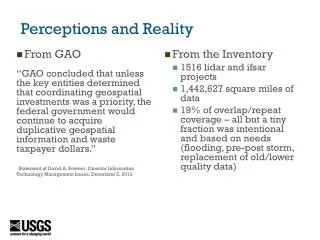
Perceptions and Reality • From GAO “GAO concluded that unless the key entities determined that coordinating geospatial investments was a priority, the federal government would continue to acquire duplicative geospatial information and waste taxpayer dollars.” Statement of David A. Powner, Director Information Technology Management Issues, December 5, 2013 • From the Inventory • 1516 lidar and ifsar projects • 1,442,627 square miles of data • 19% of overlap/repeat coverage – all but a tiny fraction was intentional and based on needs (flooding, pre-post storm, replacement of old/lower quality data)
Why Does This Matter? • Despite being the largest economy on Earth, we compare poorly to other developed nations in terms of investment in our geospatial infrastructure • The UK Ordnance Survey last year had an operating budget of $180m to map 94k sq miles ($1,915 per sq mile) • The NGP budget was $60m to map 3.8m sq miles ($15 per sq mile) • Whose citizen’s are better served?
Missed Opportunities • The real story in the geospatial community is lack of investment • For lack of $146m per year over 8 years we will lose $1.2 -13 billion in benefits every year while we chase down the last 1 or 2 percent of duplicative investment • Google Oxera study – global geo-services up to $270 billion annually in revenue • Is the US leading that market?