Download
1 / 1
10 likes | 133 Views
This project aims to develop a technique for transforming UML diagrams into a formal notation (colored Petri nets) to facilitate formal analysis. It includes developing tools for simulation, behavior reasoning, and checking system properties.

E N D
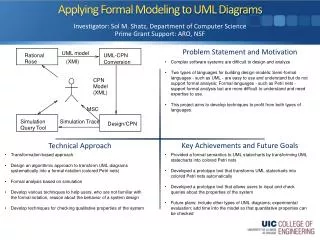
UML model Rational UML-CPN Rose (XMI) Conversion CPN Model (XML) MSC Simulation Simulation Trace Design/CPN Query Tool Applying Formal Modeling to UML Diagrams Investigator: Sol M. Shatz, Department of Computer Science Prime Grant Support: ARO, NSF • Complex software systems are difficult to design and analyze • Two types of languages for building design models: Semi-formal languages - such as UML - are easy to use and understand but do not support formal analysis; Formal languages - such as Petri nets - support formal analysis but are more difficult to understand and need expertise to use. • This project aims to develop techniques to profit from both types of languages. • Transformation based approach • Design an algorithmic approach to transform UML diagrams systematically into a formal notation (colored Petri nets) • Formal analysis based on simulation • Develop various techniques to help users, who are not familiar with the formal notation, reason about the behavior of a system design • Develop techniques for checking qualitative properties of the system • Provided a formal semantics to UML statecharts by transforming UML statecharts into colored Petri nets • Developed a prototype tool that transforms UML statecharts into colored Petri nets automatically • Developed a prototype tool that allows users to input and check queries about the properties of the system • Future plans: include other types of UML diagrams; experimental evaluation; add time into the model so that quantitative properties can be checked