Download
1 / 49
490 likes | 622 Views
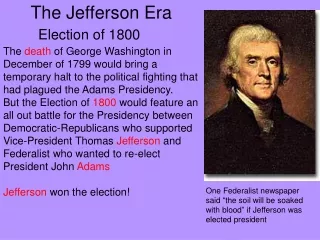
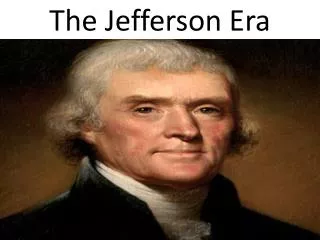
The Jefferson Era marked a pivotal time in American history with significant events and figures shaping the nation. This period includes the conflict between Federalist John Adams and Republican Thomas Jefferson during the 1800 election, the establishment of judicial review through the landmark Marbury v. Madison case, and the American expansion following the Louisiana Purchase. Key figures like John Marshall, Sacagawea, and Napoleon Bonaparte played vital roles, influencing governance, territorial growth, and international relations. Join us as we delve into these transformative years.

E N D
John Adams • 2nd President of the United States • Federalist candidate in 1800 election • Charles Pinckney was his vice presidential running mate
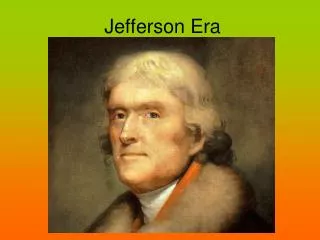
Thomas Jefferson • 3rd President of the United States • Republican candidate in the 1800 election • Aaron Burr was his vice presidential running mate
Laissez-faire • Policy that government should interfere as little as possible in the nation’s economy • Thomas Jefferson’s policy for government
Custom Duties • Taxes on foreign imported goods
Judiciary Act • Set up regional courts for the United States
John Marshall • Appointed chief justice of the Supreme Court by outgoing president John Adams
“Midnight Judges” • Judges appointed by President John Adams in the final hours of his presidency • They were not recognized by new President Thomas Jefferson • Led to the Marbury v. Madison case
Marbury v. Madison • First time the Supreme Court reviewed and ruled on acts of the other branches of government • Established the power of judicial review
Judicial Review • The rights of the Supreme Court to determine if a law violates the Constitution • Has become a basic part of the system of checks and balances
3 Principles of Judicial Review • The Constitution is the supreme law of the land • When there is a conflict between the Constitution and any other law, the Constitution must be followed • The judicial branch has a duty to uphold the Constitution
Conestoga Wagons • Sturdy vehicles topped with white canvas and used by pioneers to move west
Louisiana Territory • Land west of the Mississippi River controlled by Spain • Secretly transferred to French control in 1802
New Orleans • The trade center for the Louisiana Territory
Napoleon Bonaparte • Leader of France from the end of the French Revolution until 1814 • Had plans for a French empire in Europe and the Americas
Toussaint-Louverture • Led a revolt in Santo Domingo against the French and set up a new government • Helped Haiti regain its independence from the French
Louisiana Purchase • A treaty in which the United States purchased the land extending from the Mississippi River to the Rocky Mountains and from Canada to the Gulf of Mexico for $15 million from France • The Purchase doubled the size of the United States
Lewis and Clark Expedition • A journey made by Meriwether Lewis and William Clark to explore the Northwestern land purchased from France • The information gathered by Lewis and Clark was very helpful in the settlement of the West
Sacagawea • Shoshone woman who joined Lewis and Clark’s expedition as a guide
Zebulon Pike • Led two expeditions through the upper Mississippi River and into present day Colorado • Discovered mountain he named Grand Peak (now known as Pikes Peak)
Secede • To leave or withdraw
Burr v. Hamilton Duel • Burr blamed Hamilton for him losing the election for governor of New York and challenged Hamilton to a duel • Hamilton pledged not to shoot Burr because he hated duels • Burr shot and killed Hamilton in Weehawken, New Jersey