Exploring Conceptual Spaces: Dimensions and Metaphors in Understanding Representation
This session delves into the framework of conceptual spaces, emphasizing their quality dimensions as foundational elements for representing various properties of objects. It discusses innate and learned dimensions, the cultural dependence of these dimensions, and their implications in scientific contexts like weight and time. By exploring spatial structures of concepts, including color spaces and acoustic frequencies, we illustrate how metaphors enable knowledge transfer between dimensions. This analysis fosters a deeper understanding of how we categorize and relate various qualities of the world.

Exploring Conceptual Spaces: Dimensions and Metaphors in Understanding Representation
E N D
Presentation Transcript
Conceptual spaces CSCTR – Session 6 Dana Retová
Conceptual spaces (Gärdenfors) • Consist of a number of quality dimensions • Building blocks of representations • Weight, temperature, brightness, pitch, height, width, depth • Abstract non-sensory dimensions • Represent various qualities of objects • Independent of symbolic representations (language) • Abstract representation for modeling • Do not claim to have any immediate physical realization
Dimensions • Innate – hardwired in nervous system • Learned • Learning involves expanding conc. Space with new quality dimensions • Culturally dependent • Time • Scientific • Weight vs. mass
Dimension of ‘time’ • In our culture and in science • One-dimensional structure isomorphic to the line of real numbers • In other cultures • Circular structure
Dimension of ‘pitch’ • 1-D structure from low tones to high • Logarithmic scale • Acoustic frequency is spatially coded in chochlea
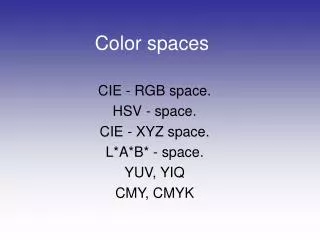
Color space • Hue • Brightness • Color
Contrast classes • Skin color • Possible colors are the subset of the full color space • Can be irregular • Subset “stretched” to form a space with the same topology • Color terms can be used even if they do not correspond to the original hues • “Metaphor”
Conceptual spaces • Similarity - defined via distance between representing points • Object – point in a conceptual space • Property/Concept – region of a conceptual space
Metaphors in conceptual space • A metaphor expresses a similarity in topological or metrical structure between different quality dimensions • A word that represent a particular structure in one quality dimension can be used as a metaphor to express a similar structure about another dimension • Metaphors transfer knowledge about one conceptual dimension to another • E.g. space mapped to time
Primary and secondary properties • Predicates are assigned regions of space (red) • Secondary properties (tall) • “Parasitical” on other properties • “Big chihuahua”
Marr (1982) • Cylinders • Length • Width • Angle between the dominating and the other one • Position of the added cylinder • Prototypical vector for an object – image schema • Subordinate cat. – subregions of the convex region
Action space • Spatio-temporal patterns of forces that generate the movement
Functional concepts • Function of an object can be analysed • Actions it affords • Functional concept = convex region in action space
Conceptual spaces • Ideal to represent • Concepts on basic level of conceptualization • Spatial-relations concepts • Rules follow from the topological structure • For example: • A point in a conceptual space will always have an internally consistent set of properties • Something cannot be blue and yellow at the same time • Everything that is green is also colored • Nothing is in the same place in the same time • Transitivity – as in “earlier than”