The Industrial Revolution
200 likes | 372 Views
The Industrial Revolution. HIST 1004 2/20/13. Republican Colonialism. 1798-1801 – Republican France colonizes Egypt Led by Napoleon Bonaparte Promises to bring freedom and Enlightenment How does colonialism bring freedom?. The French and Saint Domingue.


The Industrial Revolution
E N D
Presentation Transcript
The Industrial Revolution HIST 1004 2/20/13
Republican Colonialism • 1798-1801 – Republican France colonizes Egypt • Led by Napoleon Bonaparte • Promises to bring freedom and Enlightenment • How does colonialism bring freedom?
The French and Saint Domingue • 1659 – French take control from Spanish • 1780’s – Produces 40% of all sugar and 60% of all coffee consumed in Europe • 1/3rd of all slaves in the Americas • Over 90% of population are slaves • Another 5% are free blacks (gens de couleur)
Haitian Revolution (1789-1804) • News of French Revolution reaches colonies • So does the revolutionary rhetoric • Gens de couleur demand rights • Expands to slave revolt • Francois Dominique Toussaint L’Overture • Former slave turned revolutionary leader • 1804 – Independent Haiti
Conservative Reactions • Congress of Vienna (1814-1815) • Reestablish old political order after French Revolution and Napoleonic Wars • Stable France is key to peace, reestablishes French monarchy. • Greek War of Independence (1821-1830) • Independence from Ottoman Empire viewed as threat to old European monarchies.
Revolutions of 1848 • Spring of Nations, Springtime of the People, the Year of Revolution • Revolutions in… • France: Overthrow the monarchy, establish the Second French Republic, ends in the rule of Emperor Napoleon III • Hungary, Italy, and Bohemia: Seeking independence from the Austro-Hungarian Empire • Berlin: Seeking constitution and German unification • All failed… • Was 2011 the Arab 1848?
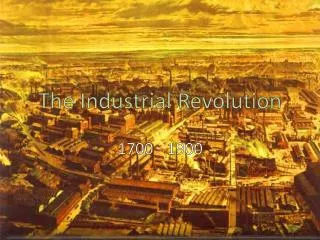
The Industrial Revolution • What does it mean when people argue that, for the vast majority of people around the world, life did not change dramatically between the Neolithic/Agricultural Revolution (8000 BC) and the Industrial Revolution (18th-19th centuries)?
Before the Industrial Revolution • Cottage Industries • Many manufactured goods, especially clothing, made at home. • In rural areas, provided work during the winter. • Merchants and Craftsmen • Raw materials delivered to craftsmen • Finished goods returned to merchants • Royal manufacturers • Trained craftsmen produced luxury goods by hand.
Causes of the Industrial Revolution • Population Growth • Resistance to disease • More reliable food supplies • Increased job opportunities led to earlier marriage led to earlier and more frequent reproduction • 1800’s 40% of British population is under 15. • British Population: • 1688=5.5 million, 1801=9 million, 1851=18 million • American Population: • 1791=4 million, 1820=9.6 million, 1860=31.5 million
Agricultural Revolution and Industrial Revolution • Increases food production to support growing cities. • Importation of the potato, doubled or tripled the amount of food per acre. • New feed crops increased availability of meat and milk. • “Enclosure” of lands, fenced and deeded lands. • Gave owners opportunities to experiment with new techniques. • Turned tenant farmers and sharecroppers into landless farm laborers.
Trade • Growing population, growing cities, and growing middle class increases demand for goods. • Traditional methods cannot keep up with demand (both in production and in lowering costs). • Spread of goods spurs demands in other fields… • Spread of tea and coffee increase demand for porcelain cups.
Why Britain? • 18th century • Rising standard of living • World’s leading exporter of craft goods. • Mining and metal industries • Largest merchant marine • Produced more ships than any other country.
Known for cheap imitations, not innovations… “The prevailing talent of English and Scotch people is to apply new ideas to use and to bring such applications to perfection, but they do not imagine as much as foreigners.” John Farey Jr., 1829
Why Britain? • Social classes not as sharply drawn as elsewhere, opportunities for social mobility. • Internal transportation network (coastline, navigable rivers, and canals) • Lack of internal duties and tolls • Allows for regional specialization.
Commercial Revolution • Commercial society • More people involved in production for export, trade, and finance • Especially related to overseas trade
Industrial Revolution 1) Mass production through the division of labor. 2) New machines and mechanization 3) Great increase in manufacture of iron. 4) Steam engine 5) Electric telegraph
Industrial Revolution • New technologies allow for increased production with less human labor. • Steamboats, ships, and railroads allow for faster spread of goods and resources needed for manufacturing.
Industrial Cities • Rapid expansion of industrial cities. • London: • 1700=500,000, 1800=959,000, 1850=2,363,000 • Manchester: • 1758=20,000 • 1850’s=400,000 • New York: • 1815=100,000 • 1850=600,000
Industrial Cities • Division between wealthy and poor districts • New industrial wealth goes into mansions, churches, museums, and theaters. • Most of the expansion is in poorer neighborhoods, cheap housing built quickly.
Industrial Cities • Poor urban planning, environmental problems • Sewage and trash • Farm animals • Horses • Air pollution • Contaminated water • “Every day that I live, I thank Heaven that I am not a poor man with a family in England.” Henry Coleman, European Life and Manners