Download
1 / 19
190 likes | 290 Views
This document outlines critical updates and priorities for teacher education in California, as discussed in the March 2014 meeting led by Dr. Mary Vixie Sandy. Key topics include adjustments to accreditation systems, the incorporation of performance assessments like the edTPA, and streamlined standards aimed at enhancing quality in teacher preparation. It addresses the need for improved accountability structures, insights into program quality, and better alignment with new educational standards. The CTC’s goals for 2014 spotlight the importance of outcome measures and innovative practices in educator training.

E N D
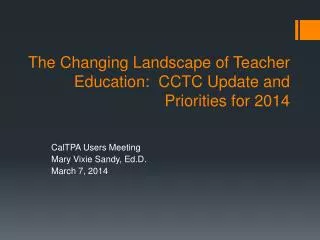
The Changing Landscape of Teacher Education: CCTC Update and Priorities for 2014 CalTPA Users Meeting Mary Vixie Sandy, Ed.D. March 7, 2014
Teacher Preparation Program Enrollment, 2007-2008 to 2011-2012
Figure 4: Statewide Certification Data for 2011-2012 • In state: • Out of state:
Demand Uptick Source: CDE Data Quest, Projected Teacher Hires
Things we’ve been working on • Operational effectiveness in discipline, credentialing, communications • Suspended, restarted accreditation site visits • New standards for Adaptive PE, WL:ELD, Admin • Modifications to standards to improve delivery of services to English learners • Alignment of TPEs and CSET with CCSS • Finalization of the TAP panel work: 40 recommendations • Review of the edTPA: approval for limited pilot • New policy to require administrators to complete an APA • Piloted a program completer survey
Need to review and update accreditation system • Procedurally cumbersome, costly and resource intensive for programs and CTC • Heavily weighted toward “inputs” • Not using performance outcome data systematically • Susceptible to attacks from other entities looking at quality in teacher preparation • Need to sharpen effectiveness and efficiency in this accountability system
Questions we are pondering… • How do we know that teacher preparation in California is • Focused on the right things? • Of high quality? • What aspects of the current system yield the greatest insight into program quality? • How can we use available performance indicators to sharpen our understanding of program quality and improve our accreditation system?
Systems that inform quality • Three interdependent systems impact quality and shape accountability in educator preparation • Standards for preparation • Performance assessments and examinations (RICA, CSET) • Accreditation • Improving quality and sharpening accountability requires attention to all three of these systems
CTC Goals for 2014 • Focus on the essentials: • Streamline and reduce the prescriptive nature of standards • Ensure they support high leverage practices, encourage innovation • Increase reliance on outcome measures • Performance assessments • Educator surveys • Employer surveys • Other indicators (admissions, program completion rates, employment rates, retention rates, etc.) • Decrease over-reliance on lengthy documentation
Improvements in TPAs • Incorporate new TPEs, Common Core Standards • Strengthen reliability within models • Create comparability across models • Incorporate results into program review • Bring Performance Assessment into Administrator licensing and accreditation
TPA Implementation • CTC is required to ensure that all candidates have demonstrated their readiness and ability to teach • CTC relies on program completion and TPAs to meet this requirement • TPAs also required by statute to shed light on program quality • Three models currently approved in CA: edTPA in pilot mode • ETS has a new model, the Pre-Professional Assessment of Teachers that may be coming to CA for piloting purposes
TPA Implementation Standards • Standard 17: Administered for Validity, Accuracy and Fairness • Consistent with design, careful monitoring, focus on equitable treatment of candidates • Standard 18:Assessor Qualifications and Training • Selection of qualified assessors, training, review • Standard 19:Administration, Resources and Reporting • Scores and data inform induction; program review; accreditation
Accountability… • The assessment standards set the right stage for consistency, but accreditation is not well suited to monitor and ensure that they are well implemented in every case • TPAs are locally implemented, and we have little to no evidence that verifies equitable implementation and consistent scoring within or across models • How can we strengthen expectations for all approved TPAs to increase consistency in scoring and reporting?
Emerging proposal • RFP to adapt, adopt or develop a new state model TPA that meets the following conditions • Comprehensive task based system that measures TPEs • Aligns with CCSS and NGSS • Multiple, Single subject and Education Specialist • One stop online system of candidate registration • Electronic platform for uploading TPAs and distributing to scorers • Centralized or locally mediated scoring, online or in person • System of scorer training, calibration, recalibration, oversight and ongoing monitoring
Emerging proposal • Recruitment of California faculty and practitioners as scorers • Comprehensive reporting system for candidates, programs and CTC for use in accreditation • More than pass / fail rates • Tied to rubrics that relate to the TPEs • Informative for the IIP process • Formative assessment, opportunities maintained in programs
Anticipated outcomes • A new state of the art statewide TPA system aligned with CSTP, CCSS, NGSS, TPEs • Consistent, comparable candidate and program outcomes • Within programs • Within institutions • Within TPA model • Across models • Multiple models still enabled by statute • must demonstrate consistent and reliable scoring • Passing standard equivalent to the state model passing standard