Collaborative Global Biological Databases: Evolution and Challenges
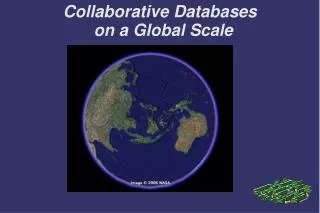
In the 1990s, the emergence of distributed biological databases sparked excitement among scientists about the vast potential of biodiversity data. Key initiatives like the Australian Virtual Herbarium and European Natural History Specimen Information Network aimed to create a single access point for querying biological data. However, challenges such as funding cuts, incompatible technologies, and unresolved database issues hindered progress. The development of a functional global network requires adaptable systems, collaboration, and common standards without losing institutional control over data.

Collaborative Global Biological Databases: Evolution and Challenges
E N D
Presentation Transcript
Background on distributed biological databases • 1990's technology boom: funding, excitement, lots of biodata not online yet, huge potential • Biology scientist meets computer scientist • Australian Virtual Herbarium (AVH) • Bio-resource network in Japan (BRnet) • European Natural History Specimen Information Network (ENHSIN) • Red Mundial de Informacion sobre Biodiversidad (REMIB) • The Species Analyst (TSA)
How it worked • Single web site, many databases • Users query *specific* biological concept • View or download single answer • Simple enough, right? ;)
Website Database Database Database
? Biological Scientist Computer Scientist (Geek)
Problem • Funding starts drying up • Major unresolved database issues • Meeting at the National Center for Ecological Analysis and Synthesis in California • Distributed Generic Information Retrieval (DiGIR) 2001 • Intense requirements engineering session • Need: common data specification • Need: common software architecture • Need: global collaboration
Requirements analysis • Worldwide biological collections contain specimen specific data and collection specific data elements. • Universal standard for an identical element set not realistic or practical • Need a broad element set domain that requires only a small subset to be functional • Institutions need to be able to control their data within a collaborative/distributed environment
Software architecture & design • Incompatible database and access technologies across the globe • Too much invested to redesign or rebuild existing systems • 2.5 billion specimen records worldwide • Adapt existing database systems to be functional in a global distributed network • PAD (Portal, Adapter, Database) existing code • Scalability, maintainability, interoperability, adaptability, usability
HerpNET DiGIR Website (Data Portal) UCB CAS NUS DiGIR Provider (Database Adapter) MySQL Excel Oracle Collections Data
Google Earth (Data Portal) TM NASA ET Data Providers (Database Adapter) Vector Raster Grid Spatial Data
Web 2.0 HerpNET
Global Amphibian Assessment Limnonectes malesianus
BioGeek Culture(Biologists and geeks working together) • Requirements analysis priority • Sharing data (community, education, policy) • Maintaining curator/museum value • Programmer analyst staff • Open source code • Advancing the state of the art in biodiverstiy informatics • Tracking data usage • Dynamic systems engineered for perpetuity