Download
1 / 12
120 likes | 237 Views
This overview discusses the controlled release of therapeutic compounds from solid polymer nanofibers. Highlighting their favorable properties such as small diameter, high surface area, and mechanical strength, the paper explores various applications, including drug delivery systems, wound dressings, and protective clothing. The controlled release mechanism is analyzed using electrospinning techniques and diffusion modeling. Future directions emphasize the characterization of release rates and investigation of organic compounds suitable for clinical applications. Research acknowledgments include institutional support and collaborative efforts.

E N D
Controlled Release from Solid Polymer Nanofibers By Elizabeth Kelley Rensselaer Polytechnic Institute Advisors: Professor Constantine M. Megaridis Professor Alexander L.Yarin Department of Mechanical and Industrial Engineering University of Illinois -Chicago
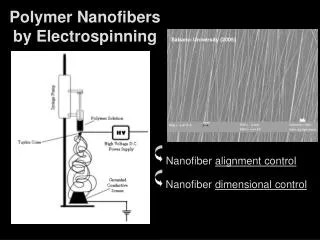
An Overview of Nanofibers • Continuous fiber • Diameter ranges from • High Surface Area- to- • High Mechanical Strength • Created from polymer 10 – 500nm Volume ratio solutions using electrospinning process http://www.chemie.uni-marburg.de/ag-wendorff/Forschung/F1-Elektrospinning_e.html
Applications of Nanofibers • Filter media • Fiber – reinforced • Solar and light sails • Protective clothing • Electronics • Several biomedical • Drug delivery systems • Scaffolds for tissue • Wound dressings plastics applications • engineering
Drug Delivery Systems Systems designed to dispense a drug in effective dosages with minimal exposure to the host
Why Polymer Nanofibers? • Reduced diameter gives rise to favorable properties for diffusion • Small diffusion distance • High surface area aids mass transfer • Convenient means of incorporating therapeutic compounds into polymer carriers • Promising method of controlling diffusion rates • Polymer Concentration • Core – Shell fibers
Characterizing Release • Fluorescent dye is added to polymer solutions • 11%, 13% and 15% Polycaprolactone (PCL) in 3:2 DMF:MC solvent mixture • Polymer solution is spun into nanofibers • Known mass of fibers is placed in water and swirled at ambient temperature • Samples of solvent are removed and analyzed using spectrofluorometer at predetermined time intervals • Cumulative release is calculated
Porosity a. b. c. . Where: ε = porosity M = mass of fiber sample ρ = density of PCL h = thickness of fiber sample S = surface area of fiber sample
Future Directions • Characterize radial diffusion from Solid Polymer Nanofibers • Continue to investigate methods of controlling release from nanofibers • Model diffusion of organic compounds for clinical applications
Acknowledgments • NSF EEC-0453432 Grant, Novel Materials and Processing in Chemical and Biomedical Engineeringdirected by C.G. Takoudis • DoD-ASSURE • NSF-REU Program • Reasearch Team • Professor Megaridis • Professor Yarin • Dr. A. Bazilevskiy • Ernest Gemeinhart • Manish Tiwari • Brian Sautter • Ilker Bayer • Joel Wise • Winnie Kuo
References • A. Theron, E. Zussman and A. L Yarin. 2001 Nanotechnology12, 384-390 • D. H. Reneker, A.L. Yarin, E. Zussman and H. Xu. 2006 Advances in AppliedMechanics 41, 1-153 • D. H. Reneker, A. L. Yarin, H. Fong, and S. Koombhongse. 2000 Journal of Applied Physics 87, 4531-4547 • E.Kenawy, G. Bowlin, K. Mansfield, J. Layman, D. Simpson, E. Sanders, G. Wnek. 2002 Journal of Controlled Release81, 57-64 • E. Zussman, A.L. Yarin, A.V. Bazilevsky, R. Avarhami, and M. Feldman. 2006 Advanced Materials18, 348-353 • G. Verreck, I. Chun, J. Peeters, J. Rosenblatt, and M. E. Brewster. 2003 Pharmaceutical Research 20, 810- 817 • G. Verreck, et. all. 2003 Journal of Controlled Release 92, 349-360 • H. Fong, I. Chun, D.H. Reneker. 1999 Polymer40 4585-4592 • H. Jiang, Y.Hu, Y. Li, P. Zhao, K. Zhu, W. Chen.2005. Journal of Controlled Release108, 237-243. • H. Jiang, Y. Hu, P. Zhao, Y. Li, K. Zhu. 2006 Journal of Biomedical Materials Research Part B: Applied Biomaterials, available at www.wileyinterscience. Com • J, Zeng, V. Tikare, K. Jacob. 2006 Langmuir22, 1322-1340 • J. Zeng, X. Xu, X. Chen, Q.Lianf, X. Bian, L. Yang, X. Jing. 2003 Journal of Controlled Release 92, 227-231 • edt. R. Dunn, R. Ottenbrite. Polymeric Drugs and Drug Delivery Systems. American Chemical Society: USA, 1991. • Y. Zhang, C.T. Lim, S. Ramakrishna, Z. Huang. 2005 Journal of Materials Science: Materials in Medicine 16, 933-946 • Y.Z. Zhang, X.Wang, Y.Feng, J. Li, C.T.Lim, S. Ramakrishna. 2006 Biomacromolecules7, 1049-1057 • Z.M. Huang, C.L. He, A. Yang, Y. Zhang, X.J. Han, J. Yin, Q. Yu. 2006 Wiley Interscience, www.interscience.com • Z. Sun, E. Zussman, A. L. Yarin, J. H. Wendorff, A. Greiner. 2003 Advanced Materials15, 1929 - 1932