Understanding Chemical Nomenclature: Naming Mono-atomic and Polyatomic Ions
20 likes | 279 Views
This guide explains the naming conventions used in chemical nomenclature for mono-atomic and polyatomic ions. Mono-atomic ions derive their names from the element forming them, with metals retaining their original names and non-metals adopting an "-ide" suffix. Polyatomic ions consist of multiple elements and often include oxygen. Their names typically end in "-ate" or "-ite," based on the central atom and its oxidation state. Examples include nitrate (NO3-), chlorate (ClO3-), and sulfate (SO42-).


Understanding Chemical Nomenclature: Naming Mono-atomic and Polyatomic Ions
E N D
Presentation Transcript
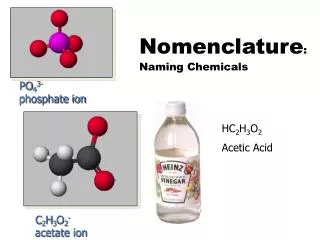
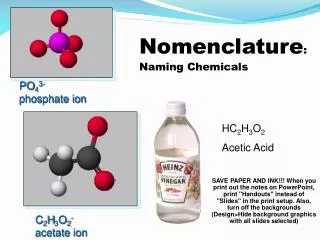
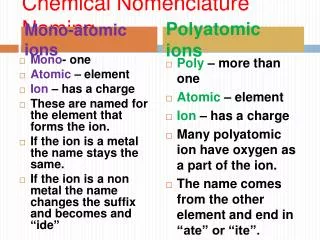
Chemical Nomenclature Naming Mono-atomic ions Polyatomic ions • Mono- one • Atomic – element • Ion – has a charge • These are named for the element that forms the ion. • If the ion is a metal the name stays the same. • If the ion is a non metal the name changes the suffix and becomes and “ide” • Poly – more than one • Atomic – element • Ion – has a charge • Many polyatomic ion have oxygen as a part of the ion. • The name comes from the other element and end in “ate” or “ite”.
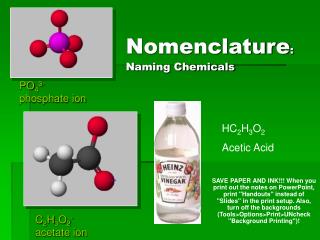
Those Poly-Oxyanions “ates and ites” ates ites • NO3- Nitrate • ClO3- Chlorate • SO42- Sulfate • PO43- Phosphate • NO2- Nitrite • ClO2- Chlorite • SO32- Sulfite • PO33- Phosphite