Understanding Work: Definition, Units, and Calculating with Force
This section explores the concept of work in physics, defined as the cumulative effect of a force moving an object from one position to another. Examples include pushing a box, raising a bucket of water, and launching satellites. We'll discuss the units of work, formulated as force times distance, and how to calculate work when forces are constant or variable. The core formula for work (W = F × d) and its applications in different scenarios illustrate the fundamental principles of work in mechanical systems, using both traditional units and SI units.

Understanding Work: Definition, Units, and Calculating with Force
E N D
Presentation Transcript
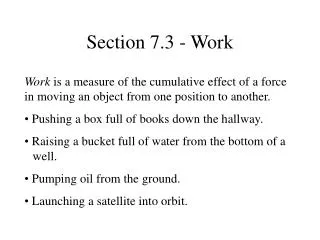
Section 7.3 - Work • Work is a measure of the cumulative effect of a force in moving an object from one position to another. • Pushing a box full of books down the hallway. • Raising a bucket full of water from the bottom of a well. • Pumping oil from the ground. • Launching a satellite into orbit.
The Units Of Work Force Distance = Work [pounds] [feet] = [ft-lb] [Newtons] [meters] = [N-m]
The Work Integral In the simplest case, we have a constant force F applied to an object to move it in a straight line from point a to point b. In this situation, the work is F·(b a). Integral calculus provides us a way to compute work when the force exerted is not constant, but varies with position x (i.e., force is a function of x, written as F(x)).