
Overcoming Group Stagnation: Strategies for Dynamic Team Development
In group dynamics, teams can encounter phases where they become stuck due to issues like individualism, cliques, or paralysis caused by information overload or the drive to be polite. Understanding these challenges is critical for progress. This session will reflect on personal experiences of stagnation within teams, exploring how groups evolve through stages: Forming, Storming, Norming, and Performing. Learn practical strategies to facilitate movement past obstacles and foster an environment conducive to growth. Participants will engage in scenarios to illustrate and address group stagnation effectively.

Overcoming Group Stagnation: Strategies for Dynamic Team Development
E N D
Presentation Transcript
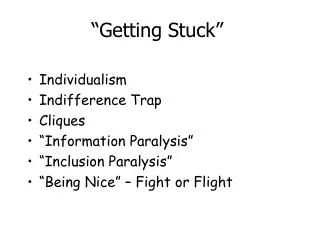
“Getting Stuck” • Individualism • Indifference Trap • Cliques • “Information Paralysis” • “Inclusion Paralysis” • “Being Nice” – Fight or Flight
Group Development • Groups evolve over time • Groups may go through different phases • Example • Forming • Storming • Norming • Performing • Group may get stuck along the way • Groups may need to take alternative approaches to get unstuck
Getting Stuck • Think about a time when you got stuck as a group • Share your experience with the rest of the team members • What did you do to get unstuck, or did you? • Pick a scenario and present to the audience (by describing and acting out the situation)